
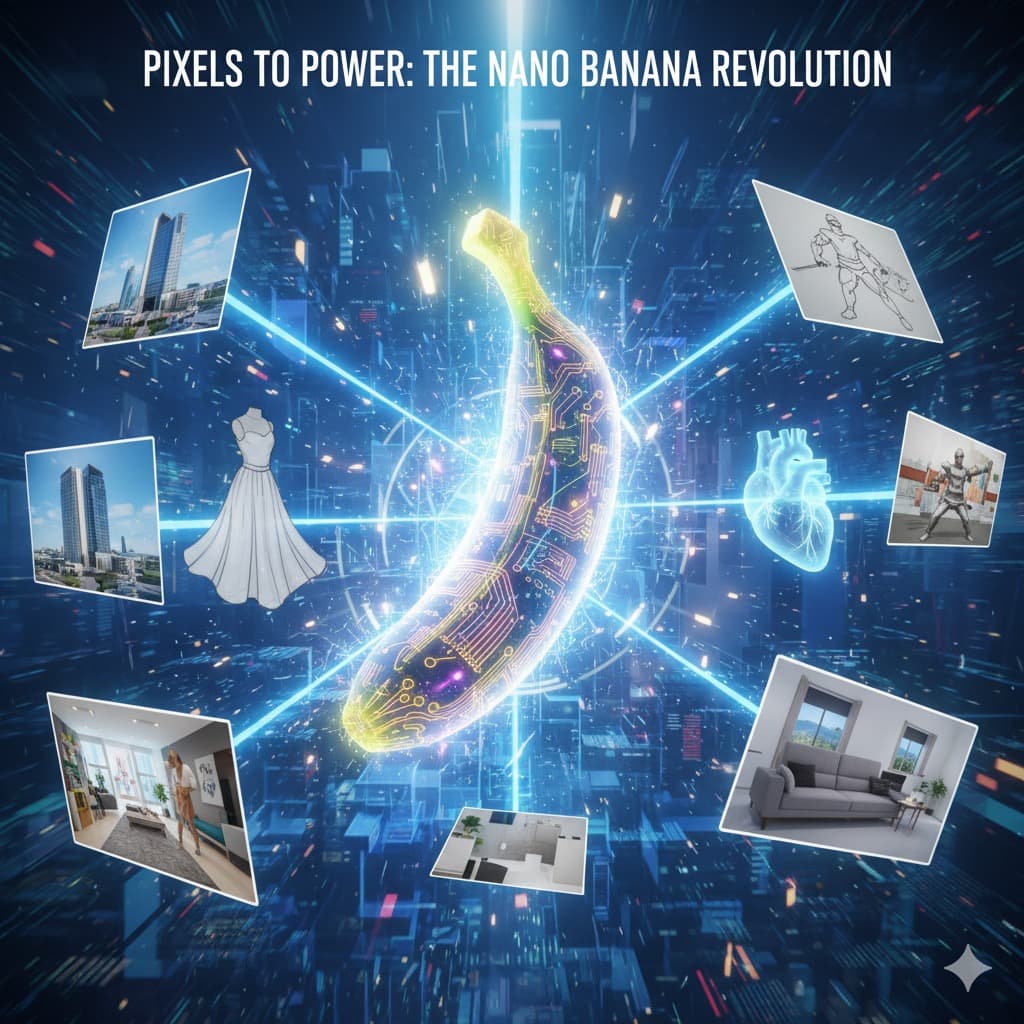
From Pixels to Power: The “Nano Banana” Revolution – A Genesis Story for the Modern Age
(Inspired by the transformative origin stories of heroes like Iron Man or Spider-Man, where an accidental discovery or a groundbreaking invention fundamentally alters the world.)
The world, as we knew it, was trapped in two dimensions. Ideas soared, but their physical manifestations lagged, bogged down by the limitations of traditional design and creation. Engineers sketched, artists painted, and marketers envisioned, but the leap from flat concept to tangible form was always an arduous, often expensive, journey. This was the “before time,” a world waiting for its catalyst.
Enter Dr. Aris Thorne, a brilliant but reclusive AI researcher working in a nondescript lab, surrounded by screens filled with complex algorithms. His passion was “dimensional translation” – finding a seamless bridge from 2D data to robust 3D reality. For years, his work was dismissed as a niche, an academic curiosity. He tinkered with neural networks, feeding them millions of images, teaching them to see not just pixels, but potential.
Then came “Project Nano Banana.” The name, a playful internal joke, belied the profound breakthrough it represented. Using a novel architecture, later integrated into what the world would know as Gemini 2.5 Flash Image, Thorne’s AI didn’t just interpret images; it understood their inherent volumetric data. With a single photograph and a simple text prompt, it could extrude, sculpt, and texture a detailed 3D model in seconds. It was like giving a static blueprint the breath of life.
The first public demonstration was almost an accident. A junior intern, playfully uploading a photo of their pet dog and typing “turn into a space-faring cyborg pug figurine,” watched in stunned silence as a perfectly rendered, customizable 3D model materialized on screen. The “Nano Banana” wasn’t just working; it was intuitive. It was revolutionary.
The Call to Adventure: Unleashing the Power
Like Tony Stark realizing the potential of his Arc Reactor beyond a mere chest implant, Dr. Thorne quickly grasped that Nano Banana was not just for quirky pet figurines. This was a tool that could fundamentally reshape industries. The initial public fascination with “turning selfies into anime heroes” was merely the tip of an immense iceberg.
The world suddenly had a new superpower: instantaneous materialization of concepts.
The Industrial Avengers Assemble: “Nano Banana’s” Impact Across the Sectors
1. The Architect’s Vision (The ‘Iron Man’ Suit for Buildings):

Imagine an architect, once painstakingly rendering every brick and beam, now able to upload a 2D blueprint and, with a few whispered commands (“modern skyscraper, glass façade, lush rooftop garden”), instantly generate a photorealistic 3D model. This is the ‘Iron Man’ suit for architectural design. It allows for rapid prototyping, visualizing client feedback in real-time, and conducting virtual walkthroughs before the first shovel hits the ground. Cities can be designed and iterated upon in a fraction of the time, fostering sustainable and efficient urban planning.
2. The E-commerce & Retail Reality Stone (Shaping Consumer Experience):

For retailers, Nano Banana is the ‘Reality Stone’, bending perception to create immersive shopping experiences. Gone are the days of flat product images. Now, a simple photo of a sofa can be transformed into an interactive 3D model, allowing customers to virtually place it in their living room via AR, change fabric textures, or even see how it looks under different lighting conditions. This reduces buyer’s remorse, boosts confidence, and turns online browsing into a dynamic, personalized journey.
3. The Healer’s Insight (The ‘Doctor Strange’ Eye of Agamotto for Medicine):

In healthcare, Nano Banana acts as the ‘Eye of Agamotto’, granting unprecedented insight. From 2D MRI or CT scans, AI generates precise, patient-specific 3D anatomical models. Surgeons can virtually rehearse complex operations, identifying potential challenges before incision. This reduces surgical risks, improves outcomes, and provides a powerful visual aid for explaining intricate conditions to patients and their families, fostering trust and understanding.
4. The Fashion Alchemist (The ‘Black Panther’ Kimoyo Beads for Design):

Fashion, often a realm of costly physical samples and long lead times, finds its ‘Kimoyo Beads’ in Nano Banana. Designers can now upload a sketch and instantly render virtual prototypes, visualizing how a garment drapes, moves, and fits on a 3D avatar. This dramatically shortens design cycles, minimizes material waste, and enables hyper-personalization, where consumers could eventually design their own clothes, seeing them virtually tailored to their body before production.
5. The Engineer’s Forge (The ‘Thor’s Hammer’ for Manufacturing):

For engineers and manufacturers, Nano Banana is ‘Mjolnir’, a tool for powerful creation. A schematic diagram can become a functional 3D prototype for industrial parts, tools, or even vehicles. This allows for rapid iteration, stress testing in virtual environments, and identifying design flaws long before costly physical production begins. It accelerates the entire product development lifecycle, bringing innovation to market at an unprecedented pace.
6. The Metaverse Weaver (The ‘Vision’ for Virtual Worlds):

In the burgeoning metaverse, Nano Banana is creating its own ‘Vision’. It’s the foundational technology for populating vast virtual worlds. Users can upload a photo of themselves and instantly generate a customizable 3D avatar. Developers can create entire digital cities, natural landscapes, and intricate props from simple concepts, enabling boundless creativity and rich, interactive virtual experiences. The metaverse is no longer just being built; it’s being grown from the seeds of 2D imagination.
The Future: A World Reshaped by Dimensional Translation
Dr. Thorne’s initial “Nano Banana” has matured into a powerful force. It’s not just about creating static models; it’s about empowering creation, democratizing design, and accelerating innovation. As the AI continues to evolve, learning nuances of material, physics, and intent, the line between the digital and the physical will blur even further. We are entering an era where imagination, once confined to the mind’s eye, can be instantly translated into tangible, manipulable 3D reality, much like a superhero’s power reshaping the world around them. And this, perhaps, is just the beginning of its true potential.
Related Insights

How Google I/O 2026 Reshuffled the Search Algorithm—And How ContentXIR Empowers Brands to Dominate the Agentic Web
Google just restructured its search core around Gemini 3.5 Flash, 24/7 background Search Agents, and dynamic Generative UI. Learn how ContentXIR’s causal engine delivers the diagnostic insights needed to survive this new age of SEO.

The Neural Search Shift Season 04: GEO Protocols (The Finale) Episode 07: A/B Testing for Algorithms
We have spent this season re-engineering your content, your code, and your PR for the Generative AI era. But how do you actually know if it is working? In the…

The Neural Search Shift Season 04: GEO Protocols (The New Playbook) Episode 06: The Itinerary Engine
For brick-and-mortar businesses, event spaces, and localized services, the game has fundamentally changed. The “Map Pack” is no longer the final destination. Users are no longer asking search engines to…