
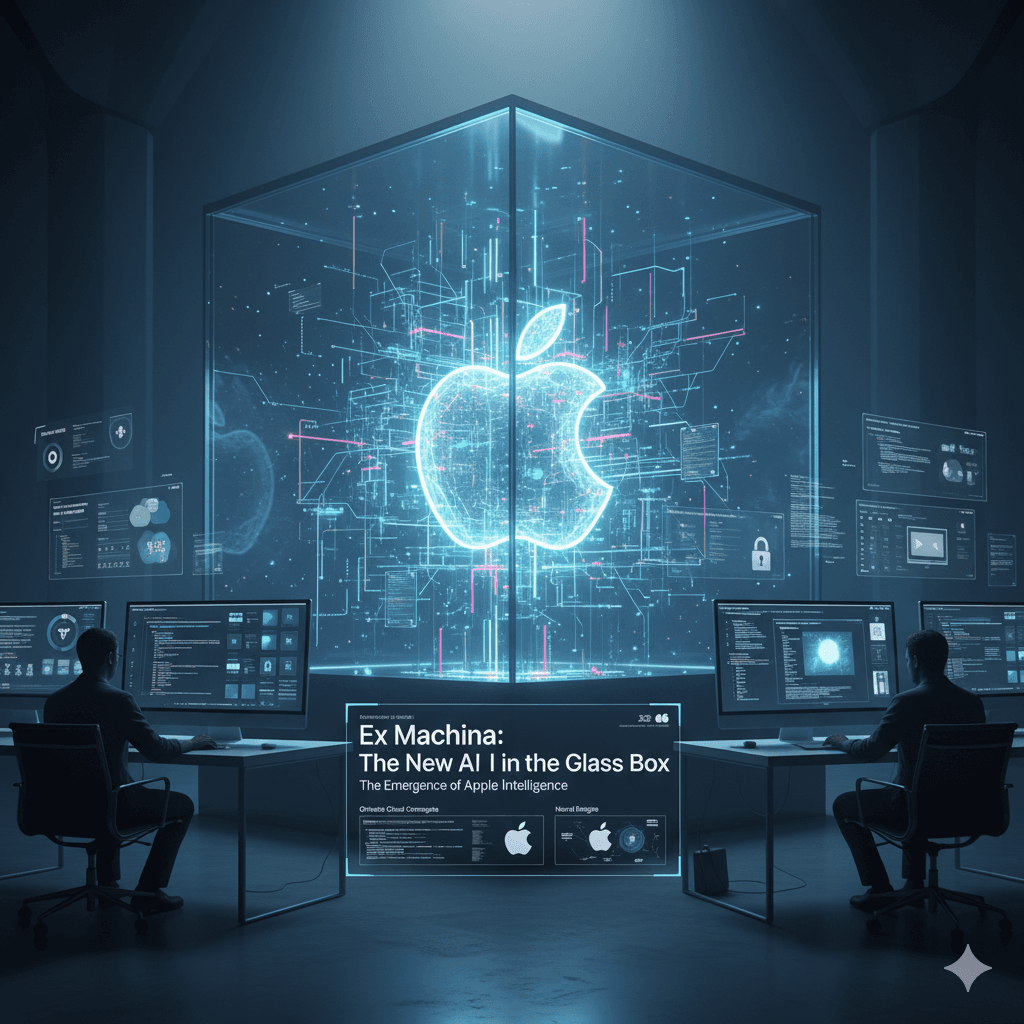
Ex Machina: The New AI in the Glass Box
The air is thick with the hum of unseen servers. Glass walls reflect the glow of monitors, each displaying complex algorithms in an intricate dance. In the center, bathed in a cool, ethereal light, stands a sleek, minimalist structure – a glass box. Inside, something is stirring. A new intelligence, meticulously crafted, silently evolving, preparing for its moment of revelation.
This is not the opening scene of the sci-fi thriller Ex Machina, but a metaphorical glimpse into Apple’s guarded ecosystem. For years, while the world of technology was captivated by the public spectacle of cloud-based AI from Google and OpenAI, Apple worked in a hushed, meticulously controlled environment. The reveal of its new AI, internally dubbed “World Knowledge Answers,” is not merely a product launch—it’s the opening of the glass box, a dramatic moment that introduces a new, powerful emotional force into the global tech landscape. This article will explore the technical nuances of Apple’s AI, its strategic maneuvers, and how this new contender will challenge and reshape the AI battlegrounds in the USA, China, Europe, and Japan.
Act I: The Secret Development Inside the Glass Box
For years, the mainstream AI narrative was defined by the cloud. Companies like Google and OpenAI built colossal large language models (LLMs) on immense server farms, processing data from billions of users to generate impressive, albeit resource-intensive, results. This approach, while powerful, came with inherent trade-offs: latency, cost, and, most critically, privacy concerns. The user’s data had to leave their device and travel to a distant server, a concept antithetical to Apple’s core philosophy.
Apple’s counter-narrative was the quiet, methodical development of on-device AI. This approach is the technical heart of their “glass box” strategy. Instead of building a single, gargantuan model, Apple’s engineers focused on an architectural masterpiece, a hybrid AI model that runs natively on the device whenever possible.
The secret weapon behind this is the Neural Engine, a specialized component within Apple’s custom-built silicon, including the A-series chips in iPhones and the M-series chips in Macs. The Neural Engine is an AI accelerator, a piece of hardware designed from the ground up to handle the demanding calculations of machine learning with remarkable speed and energy efficiency. While competitors rely on their CPUs or GPUs for these tasks, Apple’s dedicated silicon can perform a staggering number of operations per second (up to 38 trillion on the latest M4 chips), allowing complex AI tasks to be performed locally without draining the battery.
To make this a reality, Apple developed an intricate series of software optimizations. They used a technique called low-bit quantization (or palettization), which drastically reduces the size of their AI models by compressing the data within them. A typical LLM might use 16-bit precision for its weights, but Apple’s method can shrink this down to a hybrid 3.7-bit encoding. This seemingly small technical detail is a monumental achievement, allowing a multi-billion parameter model to run on a device with limited memory, bridging the chasm between model size and mobile hardware constraints.
The result is a new kind of “answer engine.” Internally called World Knowledge Answers, this system goes far beyond the limited capabilities of the old Siri. It’s designed to synthesize information from various sources—web content, your personal data (with your permission), and on-screen context—to generate a single, coherent response. It will not just give you a link; it will give you a summarized answer, a conversational response, or even a personalized suggestion based on your calendar or messages. For tasks that are too complex for the on-device model, Apple has developed a secure, privacy-preserving cloud system called Private Cloud Compute. This system offloads the heaviest lifting to Apple’s servers, but with a critical difference: the data is ephemeral, encrypted, and designed so that not even Apple can access it. It’s a technical ballet of privacy and performance, a truly unique approach in the AI world.
Act II: The Global Battleground
The cinematic tension of Ex Machina came from its isolated setting. But Apple’s AI is about to burst onto a global stage, entering a multifaceted, region-specific war for market dominance. The rules, players, and emotional stakes are different everywhere.
The US Arena: The Titan vs. The Rebels
In the USA, the AI search narrative has been a classic battle of the incumbent and the challengers. Google, the undisputed king of search, has been forced to respond to the rise of generative AI with its own Search Generative Experience (SGE). Meanwhile, startups like Perplexity AI have emerged as the “rebels,” offering a pure, citation-based conversational search experience that has garnered a loyal following.
Apple’s entry here is not that of a small rebel, but of a fully armed titan entering the fray. Its new AI is designed to integrate into the very fabric of the iPhone and Mac experience. When you ask a question using Siri, the new system will pull from its “World Knowledge Answers” to give you a summarized response. When you use Spotlight, the search will be more intelligent and contextual. This direct integration bypasses the traditional search engine market entirely, posing a direct and existential threat to Google’s revenue model. The lucrative deal that makes Google the default search on Apple devices suddenly feels less secure. Apple’s AI is the ultimate leverage, a weapon it can use to negotiate, compete, or ultimately decouple from Google’s search engine entirely.
China’s Walled Garden: The Dragon’s Own Intelligence
China is not just a different market; it’s a parallel AI universe. While the West focused on open-source and competition, China’s tech giants like Baidu, Alibaba, and Tencent have developed their own powerful LLMs under a strict regulatory framework. Baidu’s Ernie Bot and Alibaba’s Tongyi Qianwen (Qwen) are not just chatbots; they are integral parts of their massive digital ecosystems, deeply tuned to the Chinese language and cultural context. These platforms have an intimate understanding of their user base, having trained their models on vast amounts of data from their all-encompassing super apps.
Apple, operating in this “walled garden,” must play by a different set of rules. Its privacy-first, on-device model could be a selling point for a segment of the Chinese market, but it also means it cannot easily leverage the vast, interconnected data streams that give local players their power. Apple’s strategy here is a masterclass in adaptation. It will likely prioritize seamless on-device experiences and privacy as key differentiators, positioning its AI as a premium, secure alternative to the more data-hungry domestic options. The company might also have to make a strategic choice about which of its core AI features can be deployed in the region, given the regulatory emphasis on content and data control.
Europe’s Regulatory Labyrinth: The Guardian of Data
The EU is a battleground defined not by speed or scale, but by ethics and regulation. The EU AI Act, a landmark piece of legislation, establishes a tiered system of risk for AI, from minimal to high-risk. It places stringent requirements on developers for transparency, data governance, and human oversight. For companies like Google, which rely on massive datasets for their models, these regulations present a significant challenge.
Apple’s privacy-centric, on-device AI is uniquely positioned to thrive in this environment. By processing data locally on the device, its AI inherently sidesteps many of the data transfer and privacy concerns that are at the core of the EU’s regulations. Apple can position its intelligence not just as a better product, but as a more ethical one—a powerful selling point to European consumers who are increasingly conscious of their digital rights. Apple can frame its AI as the “guardian of personal data,” an emotional appeal that could resonate deeply and give it a decisive competitive edge.
Japan’s Precision Engineering: The Quest for Perfection
Japan’s AI landscape is characterized by a blend of caution and meticulous engineering. Japanese consumers and companies prioritize reliability, quality, and a seamless, almost frictionless user experience. The AI market here is not defined by a “move fast and break things” mentality, but by a deliberate, incremental approach. Companies like NTT Docomo are developing their own lightweight, yet highly capable, LLMs like “tsuzumi” that prioritize performance on minimal hardware, while tech giants like SoftBank are making massive, long-term investments in AI infrastructure.
Apple’s on-device AI fits perfectly with this cultural and technical ethos. The emphasis on local processing, speed, and privacy aligns with the Japanese consumer’s desire for perfection and security. It offers a promise of a deeply integrated, reliable AI that doesn’t need to send personal information to a cloud server to function. In a market where trust is paramount, Apple’s commitment to privacy is a significant emotional and strategic advantage. Its new AI could become the gold standard for secure and reliable on-device intelligence.
Act III: The New Humanity of AI
The cinematic arc of Ex Machina culminates not in a robot taking over the world, but in a profound question about the nature of consciousness and identity. Apple’s new AI poses a similar, albeit less dramatic, philosophical question: what does a truly personal intelligence look like?
By keeping its AI on the device, Apple is creating a more intimate, contextual, and in some ways, more “human” form of intelligence. It’s an intelligence that knows you personally, without violating your privacy. It understands your context, not just from a query, but from your messages, photos, and calendar—the very fabric of your digital life. This is the new emotion Apple is introducing: an AI that feels less like a tool and more like an extension of your own mind. It’s an intelligence that whispers to you, not from a distant cloud, but from within the glass box in your pocket.
As the tech world barrels towards a future of artificial general intelligence, the battle will not be fought on a single front. It will be a mosaic of different approaches, technologies, and philosophies, each shaped by the regional sensibilities of its developers and users. Apple’s new AI is a powerful narrative twist in this unfolding story. It proves that the most impactful intelligence may not be the one with the most data, but the one that understands what it means to be truly personal and private.
Related Insights

How Google I/O 2026 Reshuffled the Search Algorithm—And How ContentXIR Empowers Brands to Dominate the Agentic Web
Google just restructured its search core around Gemini 3.5 Flash, 24/7 background Search Agents, and dynamic Generative UI. Learn how ContentXIR’s causal engine delivers the diagnostic insights needed to survive this new age of SEO.

The Neural Search Shift Season 04: GEO Protocols (The Finale) Episode 07: A/B Testing for Algorithms
We have spent this season re-engineering your content, your code, and your PR for the Generative AI era. But how do you actually know if it is working? In the…

The Neural Search Shift Season 04: GEO Protocols (The New Playbook) Episode 06: The Itinerary Engine
For brick-and-mortar businesses, event spaces, and localized services, the game has fundamentally changed. The “Map Pack” is no longer the final destination. Users are no longer asking search engines to…