
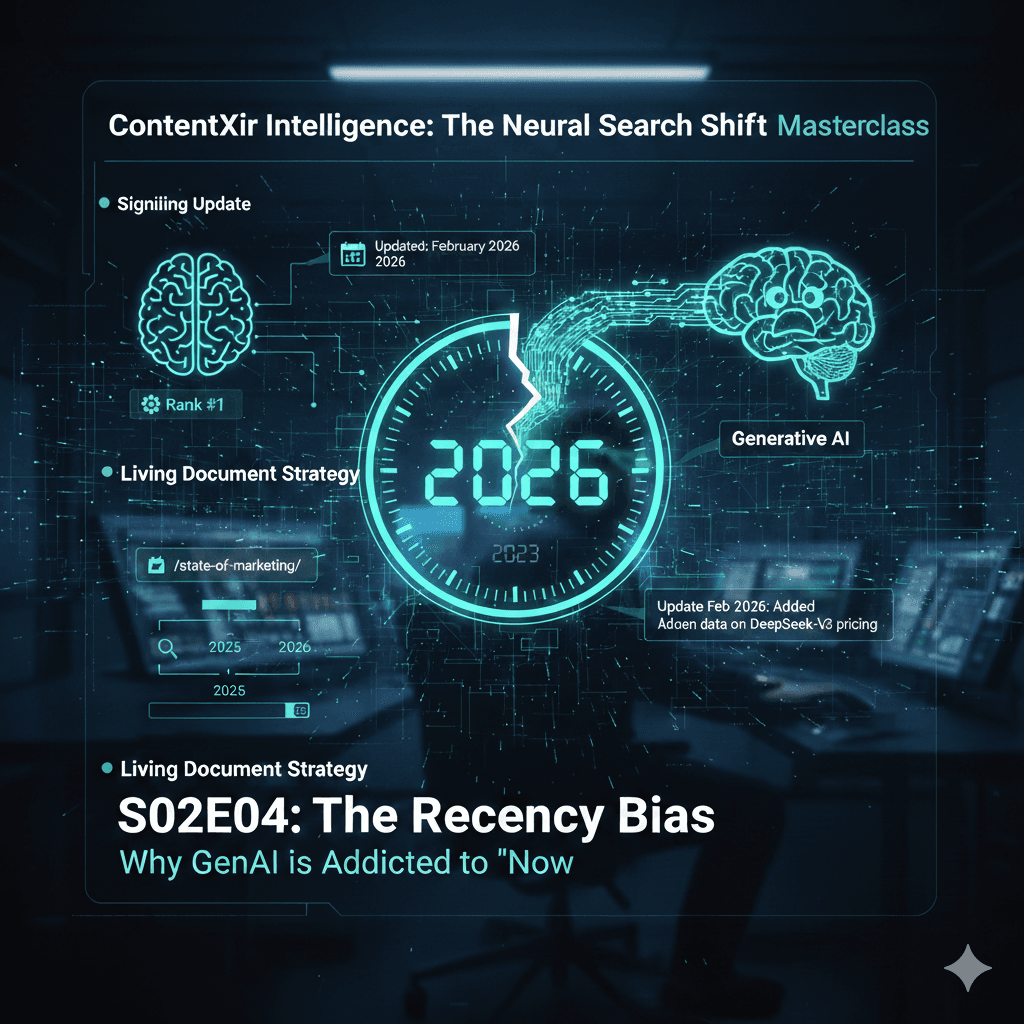
The Recency Bias | Why GenAI is Addicted to “Now”
We have discussed how to be cited. Now we discuss when to be cited. Generative AI has a massive insecurity: it knows its internal memory is outdated. Therefore, it over-corrects by prioritizing the absolute freshest data it can find. This episode is about exploiting that insecurity.
Every Large Language Model (LLM) suffers from “Frozen Knowledge.” Its training data cuts off at a specific date in the past. To compensate, RAG (Retrieval-Augmented Generation) engines are programmed with a heavy Recency Bias. They crave the newest information to answer user queries accurately. In this episode, we explore why “Updated” content now outranks “New” content, and how to signal to the AI that you are the current source of truth.
Part 1: The Decoder (The Science)
The Knowledge Cutoff & The Bridge
To an engineer, an LLM is a time capsule. If GPT-4 was finished training in late 2023, it doesn’t know who won the 2024 Super Bowl. It is frozen in time.
1. The “Temporal Gap” When a user asks a question, the Search Engine (the “Wrapper” around the AI) calculates the probability that the answer has changed since the training cutoff.
- Query: “Who is the President?” (High probability of change).
- Query: “Who wrote Hamlet?” (Zero probability of change).
- If the probability of change is high, the Retrieval Weight for “Freshness” skyrockets.
2. The Timestamp Signal To bridge the gap, the RAG system scans the live web. It looks for Temporal Anchors:
<lastmod>tags in XML sitemaps.- Visible dates on the page (“Updated: February 2026”).
- Time-sensitive entities in the text (e.g., mentioning “iPhone 17” proves the text is recent).
- The Logic: If Document A is from 2022 and Document B is from 2026, the RAG system will almost always choose Document B for “Current State” queries because it reduces the risk of hallucinating obsolete facts.
Part 2: The Strategist (The Playbook)
The “Living Document” Strategy
In the old world, you wrote a blog post, published it, and moved on. In the Recency Economy, that is a waste of equity.
1. Stop Publishing New URLs Do not create “State of Marketing 2025” and then a separate URL for “State of Marketing 2026.”
- The Strategy: Maintain one “Living URL” (e.g.,
/state-of-marketing/). - The Move: Update the same page every year (or quarter). Change the H1 to reflect the new date.
- Why: You keep the historical backlinks (Authority) while updating the content date (Freshness). This is the “Double Threat” that RAG engines love.
2. The “Signaling” Update You need to prove to the bot that the content is actually new, not just a changed date stamp.
- The Strategy: Add a “What’s New in [Current Month/Year]” section at the very top.
- Example: “Update Feb 2026: Added new data on DeepSeek-V3 pricing.”
- Why: When the bot crawls the page and sees unique, time-stamped entities (DeepSeek-V3) near the top, it validates the “Freshness” signal and indexes the new version immediately.
3. Injecting “Current Events” Even evergreen content (like “How to boil an egg”) can decay.
- The Strategy: Periodically refresh introductions to reference current contexts.
- Example: “With rising energy costs in 2026, efficient cooking is more important than ever…”
- Why: This tells the Semantic Processor that this guide is being maintained in the present, differentiating it from the 10,000 other guides written in 2015.
ContentXir Intelligence
The “Decay Rate” Metric At ContentXir, we track Content Decay—the speed at which a URL loses its visibility in AI Overviews.
- The Insight: For “News” or “Tech” topics, the Decay Rate is rapid (roughly 3-6 weeks). If you haven’t touched the article in 6 weeks, the AI assumes it is stale.
- The Fix: We use an automated “Freshness Score.” If a high-value page drops below a certain score, it triggers an alert to the content team: “Update the stats on this page immediately.”
Action Item for S02E04: The “Title Tag” Refresh.
- Identify 3 “Evergreen” posts that are slipping in traffic.
- The Task: Update the Title Tag and H1 to include the current year (e.g., “Best CRMs for Small Business [2026 Update]”).
- Add one paragraph to the intro citing a specific event or stat from the last 3 months.
- Resubmit the URL in Search Console. Watch the citation rate climb.
Next Up on S02E05:
- Title: Visual Search & Multi-Modal Indexing
- Topic: The AI doesn’t just read text anymore. It looks at images. We explore how “Computer Vision” is changing SEO and why your stock photos are hurting your ranking.
Related Insights

How Google I/O 2026 Reshuffled the Search Algorithm—And How ContentXIR Empowers Brands to Dominate the Agentic Web
Google just restructured its search core around Gemini 3.5 Flash, 24/7 background Search Agents, and dynamic Generative UI. Learn how ContentXIR’s causal engine delivers the diagnostic insights needed to survive this new age of SEO.

The Neural Search Shift Season 04: GEO Protocols (The Finale) Episode 07: A/B Testing for Algorithms
We have spent this season re-engineering your content, your code, and your PR for the Generative AI era. But how do you actually know if it is working? In the…

The Neural Search Shift Season 04: GEO Protocols (The New Playbook) Episode 06: The Itinerary Engine
For brick-and-mortar businesses, event spaces, and localized services, the game has fundamentally changed. The “Map Pack” is no longer the final destination. Users are no longer asking search engines to…