
From Strings to Things | how knowledge graph is critical factor in unlocking search visibility
This episode unlocks the single most stable component of modern search. While LLMs (the text generators) can be flighty and hallucinate, the Knowledge Graph is the bedrock of truth. If you want your brand to be treated as a “Fact” rather than a “Prediction,” you must master this.
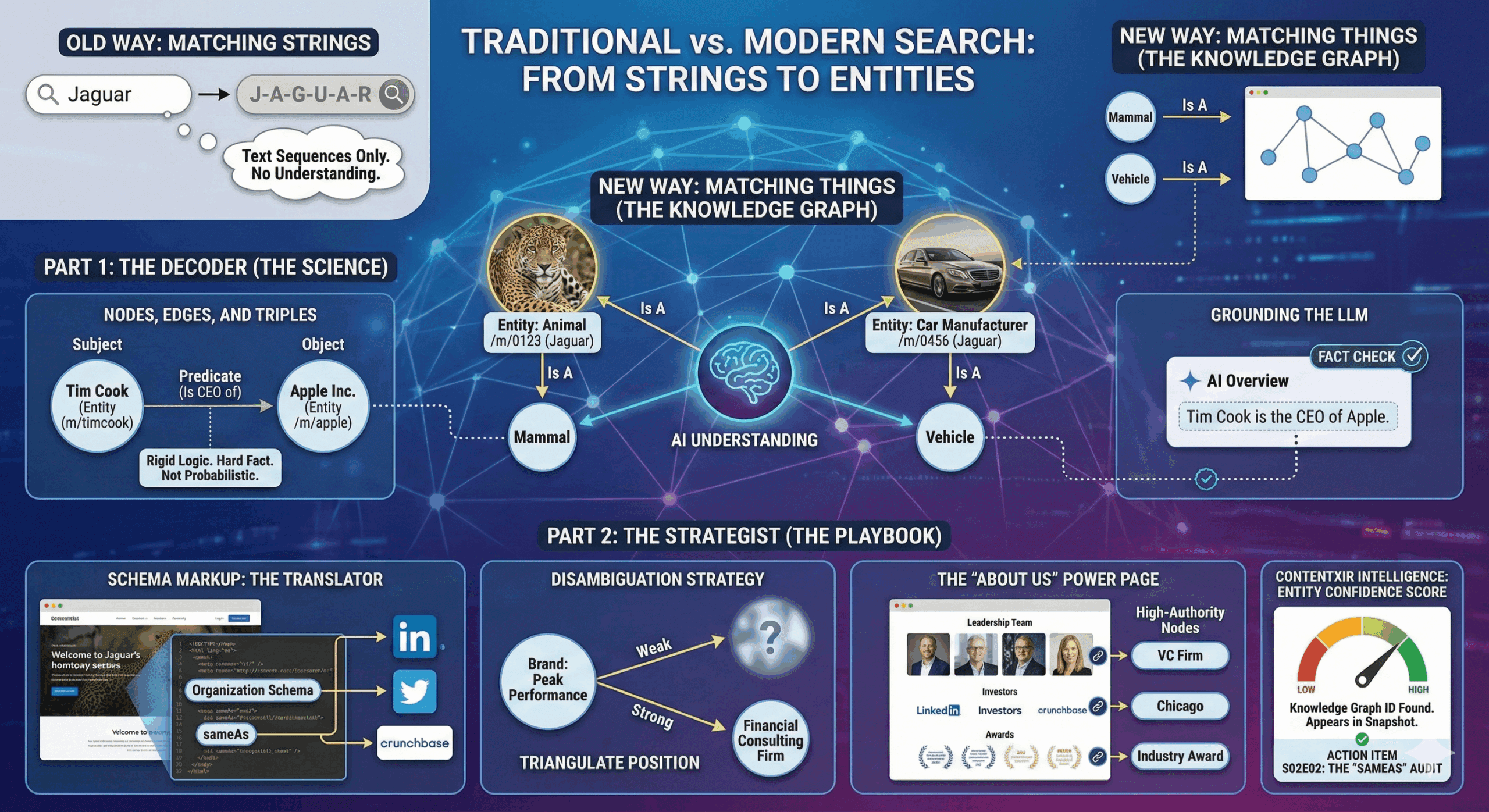
Traditional search engines matched “Strings” (sequences of characters). If you searched for “Jaguar,” it looked for the letters J-A-G-U-A-R. Modern search engines match “Things” (Entities). They know that “Jaguar” is an animal and a car manufacturer, and they know the difference instantly. This database of real-world connections is called the Knowledge Graph. In this episode, we learn how to turn your brand into a recognized “Entity” so the AI stops guessing who you are.
Part 1: The Decoder (The Science)
Nodes, Edges, and Triples
The Knowledge Graph (KG) is not a list; it is a web. It maps the relationships between real-world objects.
1. “Things, Not Strings”
Google’s mantra since 2012.
• A String is just text: “Elon Musk”.
• An Entity is a unique ID in the database: /m/03_3d (Google’s ID for Elon Musk).
• When the AI reads your content, it tries to “resolve” your text strings into these Entity IDs.
2. The Logic of Triples
The KG stores data in a specific format called a “Triple”: Subject > Predicate > Object.
• Subject: Tim Cook
• Predicate: Is CEO of
• Object: Apple Inc.
• This logic is rigid. It is not probabilistic like an LLM. It is a hard fact.
3. Grounding the LLM
This is crucial: LLMs are creative; Knowledge Graphs are factual.
• When Google AI Overviews generates an answer, it uses the Knowledge Graph to “Ground” the LLM.
• It checks the generated text against the KG facts to prevent hallucinations. If your brand is not in the Graph (or strongly connected to it), the AI has no “anchor” to verify facts about you, so it might ignore you entirely to play it safe.
Part 2: The Strategist (The Playbook)
Entity Optimization (The New SEO)
Your goal is to stop optimizing for keywords and start optimizing for Entity Resolution. You want the search engine to unambiguously identify your brand, your product, and your leadership as unique entities.
1. Schema Markup: The Translator
The most direct way to speak to the Knowledge Graph is Structured Data (Schema.org).
• The Strategy: Do not rely on Google “figuring out” that you are a software company. Tell them.
• Use Organization schema on your homepage. Define properties like founder, sameAs (links to Wikipedia/Crunchbase), areaServed, and contactPoint.
• This feeds the “Triples” directly into the engine.
2. Disambiguation Strategy
If your brand name is generic (e.g., “Peak Performance”), the AI is confused. Are you a gym? A consultancy? A car part?
• The Strategy: Create strong “Is-A” relationships in your content.
• Always qualify your brand name with its Category Entity.
• Weak: “Peak Performance helps you grow.”
• Strong: “Peak Performance is a Financial Consulting Firm based in Chicago.”
• By linking your unknown entity (Brand) to known entities (Financial Consulting, Chicago), you triangulate your position in the graph.
3. The “About Us” Power Page
Most “About” pages are fluff. They need to be Entity Maps.
• The Strategy: List your Leadership Team (Entities), your Investors (Entities), and your Awards (Entities).
• Link to their LinkedIn profiles or Wikipedia pages.
• Why: You are borrowing authority. By connecting your “Node” to high-authority “Nodes” (like a famous VC firm or a major industry award), you increase the “Confidence Score” of your own entity.
ContentXir Intelligence
The “Entity Confidence” Score
At ContentXir, we analyze how “confidently” a search engine can identify a brand.
• Low Confidence: The engine sees the string “ContentXir” but isn’t sure if it’s a typo or a company. Result: No AI Overview appearance.
• High Confidence: The engine has a Knowledge Graph ID for the brand. Result: It appears in the “Snapshot” with a logo and facts.
The Insight: You don’t need a Wikipedia page to be in the Knowledge Graph. You just need consistent, corroborated data across the web (Crunchbase, LinkedIn, Homepage Schema) that convinces the algorithm you exist.
Action Item for S02E02:
The “SameAs” Audit.
1. Go to your website’s Schema settings (or use a Schema validator tool).
2. Check the sameAs property in your Organization markup.
3. The Task: Ensure it links to every major profile you own: LinkedIn, Twitter, Crunchbase, YouTube, Facebook.
4. These links act as “digital verification” that connects all your scattered profiles into one unified Entity.
Next Up on S02E03:
• Title: The Citation Economy
• Topic: How to win the “Footnote.” Search engines are turning into academic papers, citing their sources. We teach you how to format your content so RAG engines prefer to link to you.
Related Insights

How Google I/O 2026 Reshuffled the Search Algorithm—And How ContentXIR Empowers Brands to Dominate the Agentic Web
Google just restructured its search core around Gemini 3.5 Flash, 24/7 background Search Agents, and dynamic Generative UI. Learn how ContentXIR’s causal engine delivers the diagnostic insights needed to survive this new age of SEO.

The Neural Search Shift Season 04: GEO Protocols (The Finale) Episode 07: A/B Testing for Algorithms
We have spent this season re-engineering your content, your code, and your PR for the Generative AI era. But how do you actually know if it is working? In the…

The Neural Search Shift Season 04: GEO Protocols (The New Playbook) Episode 06: The Itinerary Engine
For brick-and-mortar businesses, event spaces, and localized services, the game has fundamentally changed. The “Map Pack” is no longer the final destination. Users are no longer asking search engines to…