
From Keywords to Coordinates | The Neural Search Shift
Today we tackle the most abstract but critical concept in GenAI: Vector Space. This explains how the AI understands that “Jaguar” is an animal in one sentence and a car in another, without you needing to explicitly tell it.
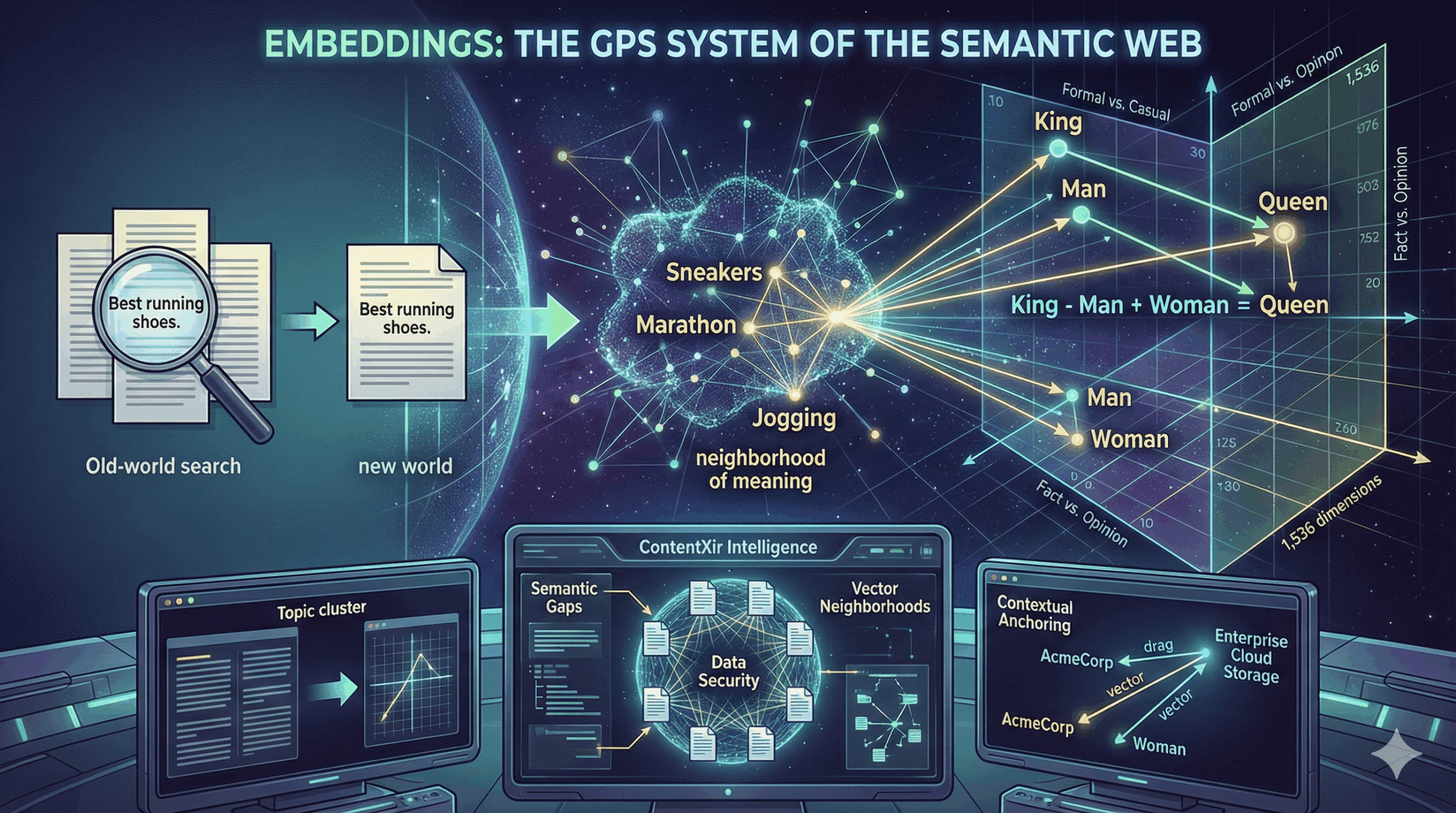
In the old world of search, if you searched for “Best running shoes,” the engine looked for pages that contained the string “Best running shoes.” In the new world, the engine doesn’t look for strings; it looks for coordinates. It understands that “Sneakers,” “Marathon,” and “Jogging” all live in the same “neighborhood” of meaning. Today, we decode Embeddings—the GPS system of the Semantic Web.
Part 1: The Decoder (The Science)
How AI Maps Meaning
To an LLM, words are not letters; they are numbers. But not just any numbers—they are coordinates in a massive, multi-dimensional map called Vector Space.
1. The “King vs. Queen” Equation The most famous example in computer science explains this perfectly. If you turn words into math, you can literally subtract concepts.
- The Formula:
King - Man + Woman = ??? - The Result:
Queen
How does the AI know this? Because in its vector space, the distance and direction between “King” and “Man” is almost identical to the distance and direction between “Queen” and “Woman.”
- It understands the concept of “Royalty” and the concept of “Gender” as mathematical directions.
2. From 2D to 1,536D A physical map has 2 dimensions (North/South, East/West).
- OpenAI’s embeddings (text-embedding-3) have 1,536 dimensions.
- This means every piece of content you write is plotted on 1,536 different axes of meaning (e.g., Formal vs. Casual, Fact vs. Opinion, Technical vs. Simple, etc.).
3. The “Neighborhood” of Relevance When a user asks a question, the AI converts their query into a vector (a coordinate).
- Then, it looks for content that is mathematically close to that coordinate.
- It doesn’t care if you used the exact keyword. It cares if your content “floats” nearby in the concept cloud.
Part 2: The Strategist (The Playbook)
Optimizing for “Vector Neighborhoods”
If search is now a game of proximity in a 3D cloud, your goal is to park your content in the “Premium Neighborhoods” where your customers are asking questions.
1. The Death of Exact Match Stop obsessing over exact keyword phrases.
- Old SEO: If the keyword is “Cheap CRM,” you must write “Cheap CRM” in the H1.
- Vector SEO: The AI knows “Cheap CRM” is semantically close to “Budget-friendly pipeline tools,” “Startup sales software,” and “Low-cost contact management.”
- The Strategy: Use Semantic Variance. Deliberately use synonyms and related concepts in your H2s and H3s to widen your “surface area” in the vector space. If you only use one term, you are a single point on the map. If you use related concepts, you become a region.
2. Topic Clusters = Vector Density You’ve heard of “Topic Clusters” (Pillar pages linking to sub-pages). Now you know why they work.
- A single blog post is a lonely point in space. It’s hard for the AI to trust its location.
- A cluster of 10 interlinked posts about “Data Security” creates a dense gravitational pull.
- The Strategy: Do not publish “Random Acts of Content.” If you write about “AI Marketing” today, you must write 3 more posts about it this week. This signals to the model: “We own this neighborhood.”
3. “Contextual Anchoring” (The Brand Hack) You need to force the AI to associate your Brand Name with your Core Service.
- The Problem: If you are a new brand (“AcmeCorp”), your vector is floating in the middle of nowhere. The AI doesn’t know what you are.
- The Fix: consistently place your Brand Name in the same sentence as your Category Entity.
- Weak: “AcmeCorp is great. We help you win.”
- Strong: “AcmeCorp provides Enterprise Cloud Storage solutions for fintech.”
- Why: You are mathematically dragging your Brand Vector closer to the “Cloud Storage” Vector.
ContentXir Intelligence
The “Semantic Gap” Analysis At ContentXir, we don’t just look for “Keyword Gaps” (words your competitor ranks for that you don’t). We look for Semantic Gaps.
- We analyze the vector space of a topic.
- Example: If everyone is writing about “CRM Features” (The ‘What’), but nobody is writing about “CRM Implementation Risks” (The ‘How’), there is a “hole” in the vector space.
- Filling that hole gives you huge Information Gain scores because you are providing unique coordinates that the AI is missing.
Related Insights

How Google I/O 2026 Reshuffled the Search Algorithm—And How ContentXIR Empowers Brands to Dominate the Agentic Web
Google just restructured its search core around Gemini 3.5 Flash, 24/7 background Search Agents, and dynamic Generative UI. Learn how ContentXIR’s causal engine delivers the diagnostic insights needed to survive this new age of SEO.

The Neural Search Shift Season 04: GEO Protocols (The Finale) Episode 07: A/B Testing for Algorithms
We have spent this season re-engineering your content, your code, and your PR for the Generative AI era. But how do you actually know if it is working? In the…

The Neural Search Shift Season 04: GEO Protocols (The New Playbook) Episode 06: The Itinerary Engine
For brick-and-mortar businesses, event spaces, and localized services, the game has fundamentally changed. The “Map Pack” is no longer the final destination. Users are no longer asking search engines to…