
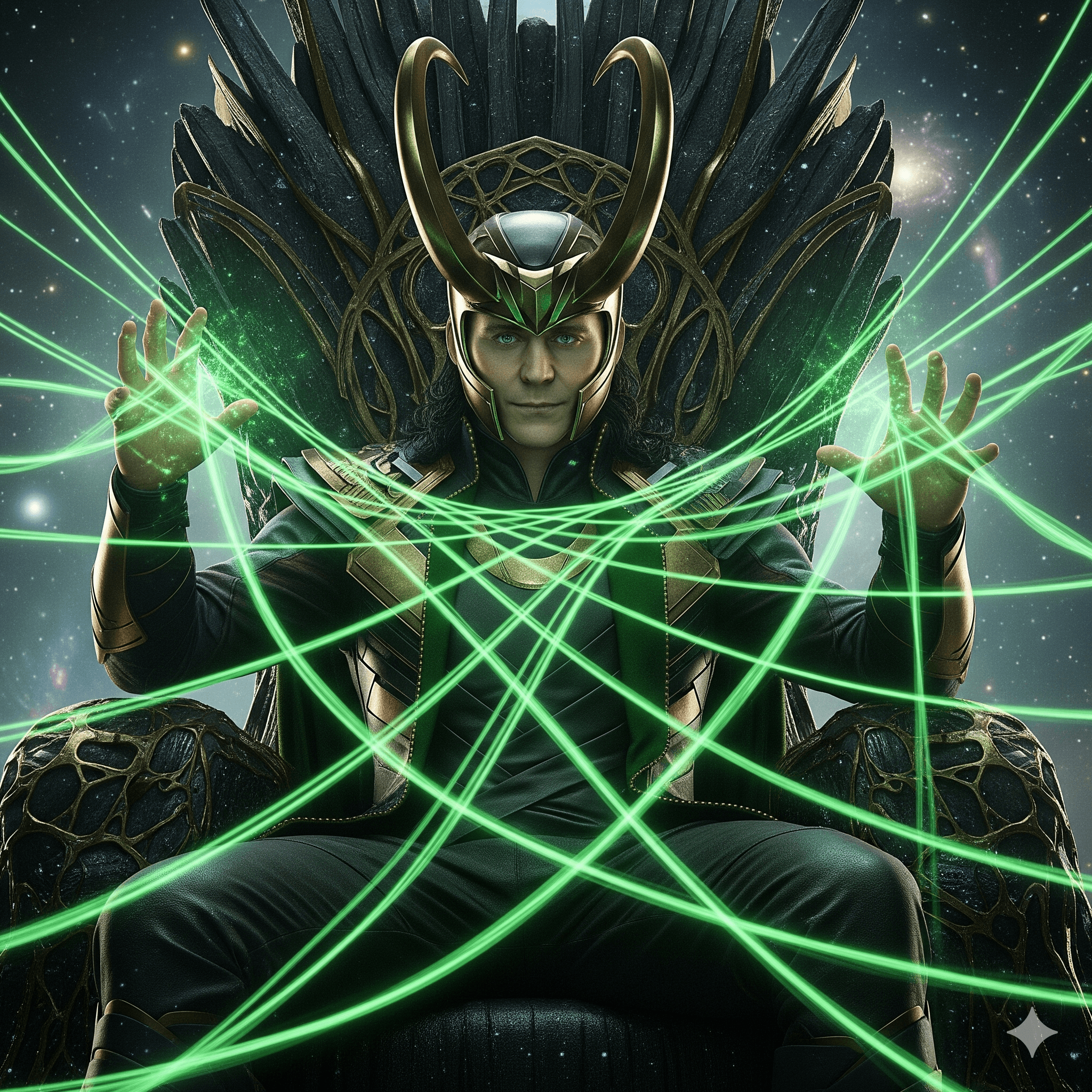
He Who Remains, and Orchestrates: Unleashing Agentic AI with the Loki Principle
The Multiverse is real. Not just in the hallowed halls of the TVA, but in the burgeoning world of Agentic AI. Imagine a myriad of specialized AI agents, each a variant of digital consciousness, pursuing their own tasks across countless digital timelines. Without a guiding hand, this could lead to utter chaos—a glorious purpose, perhaps, but one fraught with digital apocalypse.
Enter the Orchestrator Agent, the “He Who Remains” of your AI ecosystem. Inspired by the mind-bending complexities of Loki Part 2’s finale, this article explores how these master agents, like the God of Stories, weave together the countless threads of individual AI actions into a coherent, purposeful narrative. We’ll delve into how orchestrators act as “Gods of Variance,” managing multiple agent timelines, and how your organization can build its own Time Variance Authority (TVA) for multi-agent coordination across industries like finance, healthcare, and smart cities.
The Loki Principle: Orchestrators as Gods of Variance
In the grand tapestry of Agentic AI, every individual agent is a Loki variant—unique, specialized, and pursuing its own sub-objective. A customer service agent handles inquiries, a logistics agent tracks shipments, a financial agent processes transactions. Each action, each decision point, creates a branching timeline of possibilities.
The Orchestrator Agent is the God of Stories, or perhaps, He Who Remains, tasked with maintaining the Sacred Timeline of your business objectives. Its role is not to execute every task, but to:
- Monitor the Multiverse: Keep an eye on the progress and outputs of all subordinate agents.
- Prune Variant Timelines: If an agent strays off course, produces suboptimal results, or enters a “nexus event” (a critical decision point), the orchestrator can intervene, re-route, or even “prune” that execution path, much like the TVA prunes divergent timelines.
- Weave the Narrative: Combine the successful outputs from various agents into a cohesive solution, ensuring all variants contribute to the overarching goal.
- Manage Resource Allocation: Like a benevolent dictator of the timeline, the orchestrator allocates computational power and access to tools (via MCP, as discussed in our previous briefing) efficiently across its agent variants.
This Loki Principle of managing variance ensures that while individual agents have autonomy, their collective actions always serve the grand design.
Technical Architecture: Building Your Own “Time Variance Authority”
Just as the TVA required sophisticated technology to manage the Sacred Timeline, so too do orchestrator agents need robust infrastructure. This is not about a single, all-powerful AI, but a well-designed system for coordination and control.
- The Citadel at the End of Time (The Orchestrator Core):
- Goal Management: Defines the high-level objective and breaks it down into sub-goals for individual agents.
- Agent Registry: A directory of all available specialized agents, their capabilities, and their access permissions.
- Workflow Engine: Maps out the logical flow of tasks, decision points, and agent handoffs.
- State Management: Keeps track of the current progress of the overall mission and the state of each subordinate agent.
- Temporal Loom (Inter-Agent Communication – A2A):
- The Agent-to-Agent (A2A) protocols are the literal threads of the Temporal Loom, facilitating secure and efficient communication between the orchestrator and its subordinate agents, and even between peer agents.
- This includes message queues for asynchronous delegation, real-time API calls for immediate responses, and event-driven architectures for reactive adjustments.
- Timelines and Branching (Execution Paths):
- The orchestrator uses advanced reasoning and planning modules to explore potential execution paths (timelines) for achieving its goals.
- When a decision point arises, it might spin off multiple “variant agents” to explore different options in parallel, evaluating their outcomes before committing to a single path.
- Pruning Mechanisms (Intervention & Correction):
- Monitoring & Telemetry: Constant vigilance over agent performance, resource consumption, and adherence to constraints.
- Rollback & Re-planning: If a timeline goes awry (e.g., an agent provides incorrect data), the orchestrator can “rewind” the affected segment and re-issue instructions or activate a different agent.
- Guardrails & Constraints: Pre-defined rules and ethical guidelines that prevent agents from straying into forbidden territories, acting as the ultimate authority on permissible actions.
Practical Applications: Nexus Events in the Real World
The power of the Orchestrator Agent extends across industries, turning complex, multi-step processes into seamless, automated workflows.
- Financial Services (The Sacred Financial Timeline):
- Use Case: End-to-end loan application processing in Mumbai.
- Orchestrator’s Role: A master orchestrator agent receives a loan application. It delegates to a “Credit Check Agent” (accessing credit bureaus via MCP), a “Fraud Detection Agent” (analyzing transaction history), and a “KYC Agent” (verifying identity via Aadhaar APIs). The orchestrator monitors all these parallel timelines. If the Credit Check Agent flags an anomaly (a “nexus event”), it can spawn a “Manual Review Agent” or even “prune” the application’s timeline if fraud is confirmed, all while ensuring compliance with Indian financial regulations.
- Healthcare (The Patient Journey Multiverse):
- Use Case: Personalized patient care coordination across multiple specialists in Bengaluru.
- Orchestrator’s Role: A patient’s care orchestrator agent manages their journey. It interacts with a “Diagnosis Agent” (analyzing symptoms and lab results via FHIR-like standards), a “Treatment Plan Agent” (proposing therapies), and a “Pharmacy Agent” (managing prescriptions). If a medication causes an unexpected side effect (a “variant timeline”), the orchestrator immediately alerts the Diagnosis Agent for re-evaluation and the Pharmacy Agent to halt further dispensing, updating the patient’s record through the Ayushman Bharat Digital Mission (ABDM) framework.
- Smart Cities (Orchestrating Urban Flow in Delhi):
- Use Case: Dynamic traffic management and emergency response.
- Orchestrator’s Role: A central orchestrator agent monitors real-time traffic data (from sensors via MCP), weather patterns, and public transport schedules. If a major accident occurs (a “nexus event”), it immediately triggers a “Traffic Rerouting Agent” (adjusting signal timings), an “Emergency Services Agent” (dispatching ambulances and police via A2A), and a “Public Announcement Agent” (informing citizens), all while coordinating with local government agencies.
Implementation Strategy: Building Your Own “TVA” for Agent Coordination
Ready to become He Who Remains for your enterprise? Here’s how to start building your own Agentic AI TVA:
- Define Your Sacred Timeline (Business Goals): Clearly articulate the overarching objectives that your multi-agent system needs to achieve. Break these down into manageable sub-goals.
- Recruit Your Variants (Specialized Agents): Identify the specific tasks that can be automated and design individual, focused AI agents for each. Leverage existing APIs and tools (MCP) to give them their unique powers.
- Establish the Temporal Loom (A2A Communication): Choose robust A2A protocols (message queues, well-defined APIs) to enable seamless, secure communication between your orchestrator and its agents.
- Design Your Citadel (Orchestrator Logic): Develop the core logic for your orchestrator agent, including goal decomposition, task delegation, monitoring, and decision-making for “pruning” or re-routing.
- Set the Guardrails (Ethical AI & Safety Protocols): Establish strict boundaries, ethical guidelines, and monitoring systems to prevent unintended consequences or “glorious purposes” that deviate from your objectives.
- Start Small, Scale Like the Multiverse: Begin with a focused use case, learn from its implementation, and then gradually expand your agent ecosystem, adding more variants and refining your orchestrator’s capabilities.
Conclusion: The Glorious Purpose of Orchestration
The Loki Part 2 finale taught us that even amidst infinite possibilities, a guiding force is essential to prevent collapse. In the world of Agentic AI, the Orchestrator Agent is that force. By embracing the Loki Principle—managing variance, pruning suboptimal timelines, and weaving a cohesive narrative from disparate actions—organizations can unlock unprecedented levels of automation and intelligence.
Building your own Time Variance Authority for Agentic AI isn’t just about efficiency; it’s about harnessing the true power of autonomous systems to navigate complexity and achieve a truly glorious purpose in the digital multiverse. The future of enterprise is not just about having powerful AI; it’s about having an AI that knows how to conduct the symphony of its own variants.
Related Insights

How Google I/O 2026 Reshuffled the Search Algorithm—And How ContentXIR Empowers Brands to Dominate the Agentic Web
Google just restructured its search core around Gemini 3.5 Flash, 24/7 background Search Agents, and dynamic Generative UI. Learn how ContentXIR’s causal engine delivers the diagnostic insights needed to survive this new age of SEO.

The Neural Search Shift Season 04: GEO Protocols (The Finale) Episode 07: A/B Testing for Algorithms
We have spent this season re-engineering your content, your code, and your PR for the Generative AI era. But how do you actually know if it is working? In the…

The Neural Search Shift Season 04: GEO Protocols (The New Playbook) Episode 06: The Itinerary Engine
For brick-and-mortar businesses, event spaces, and localized services, the game has fundamentally changed. The “Map Pack” is no longer the final destination. Users are no longer asking search engines to…