
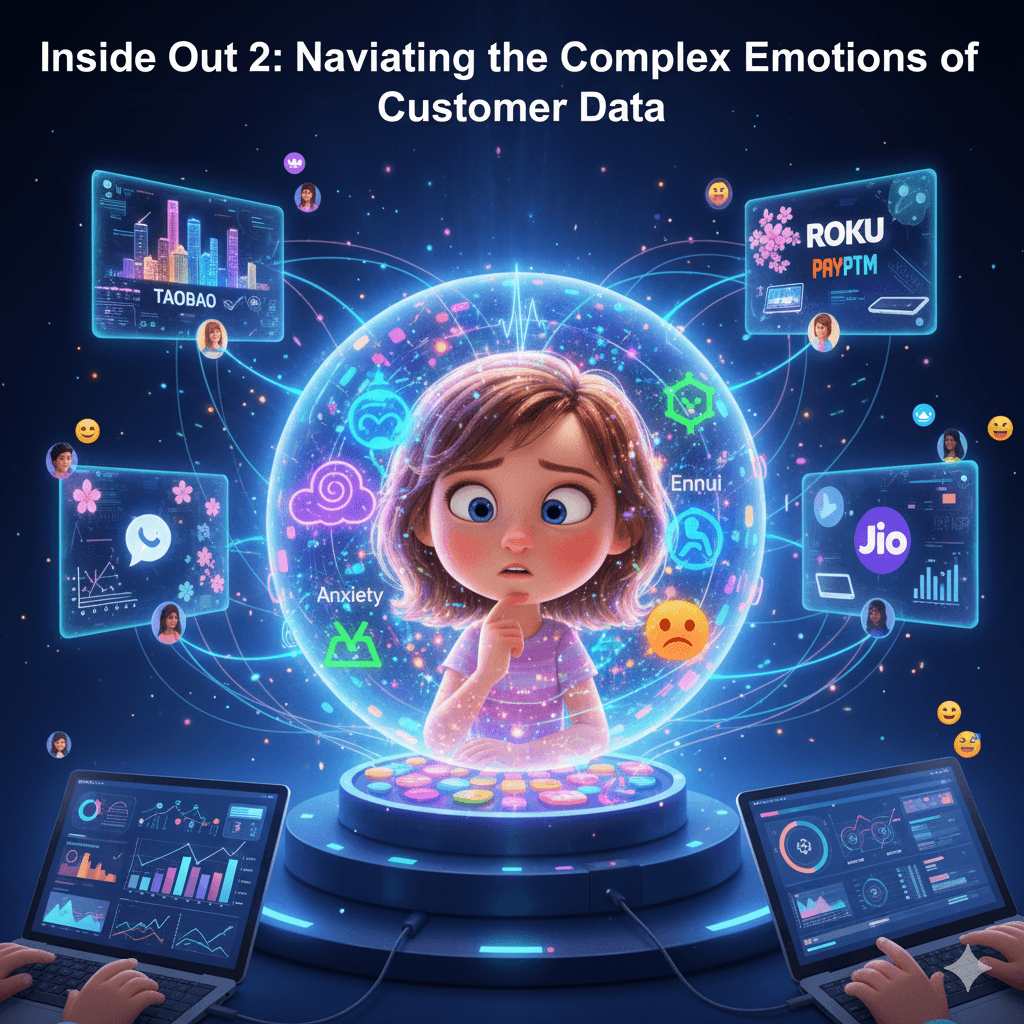
Inside Out 2: Navigating the Complex Emotions of Customer Data
Just as Riley in Disney-Pixar’s Inside Out 2 experiences a whirlwind of new, more complex emotions with the arrival of Anxiety, Envy, Ennui, and Embarrassment, businesses today are grappling with an increasingly intricate landscape of customer sentiment. The days of simply categorizing customers into “happy” or “unhappy” are long gone. In our rapidly evolving digital ecosystem, understanding the nuances of customer emotions and leveraging data to anticipate these shifts is not just an advantage – it’s a necessity for survival and growth.
The Evolving Emotional Palette of the Digital Consumer
The original Inside Out brilliantly illustrated how core emotions drive our decisions. Inside Out 2 takes this a step further, demonstrating that as we mature, our emotional responses become more layered and interconnected. The same holds true for customer behavior. A customer might express “satisfaction” with a product, but beneath the surface, there could be “anxiety” about its long-term reliability, “envy” towards a competitor’s offering, or “ennui” with a repetitive user experience.
Tech Evolution: The Sensory Overload and Emotional Footprint
The explosion of digital touchpoints has created a vast, intricate web of customer interactions. From social media feeds and online reviews to in-app behavior and IoT device data, every click, swipe, and spoken command leaves an emotional footprint.
- AI and Machine Learning: Advanced AI algorithms are no longer just identifying keywords; they’re parsing sentiment, detecting sarcasm, and even predicting emotional states based on tone of voice in customer service interactions. Imagine an AI detecting a rising level of “frustration” in a customer’s voice and proactively offering a solution before they explicitly complain.
- Predictive Analytics: Beyond reactive responses, predictive analytics, fueled by deep learning, can anticipate emotional shifts. If a customer consistently engages with content about sustainable products, an algorithm might predict their “anxiety” about environmental impact and tailor future communications accordingly.
- Immersive Technologies (VR/AR): As VR and AR become more mainstream, they offer new dimensions for understanding emotional responses. How does a customer feel when virtually trying on clothes, or experiencing a digital tour? Their physiological responses, tracked through these technologies, could provide invaluable emotional data.
- Hyper-Personalization at Scale: The goal is no longer just personalization, but hyper-personalization that resonates on an emotional level. This means understanding individual emotional triggers and tailoring content, product recommendations, and even customer service interactions to align with their current emotional state.
Global Emotional Landscapes: A Mosaic of Digital Ecosystems
The “one-size-fits-all” approach to customer emotion is not only outdated but culturally insensitive. Different regions, shaped by their unique digital ecosystems, foster distinct emotional behaviors and expectations.
- China: The Emotional Pulse of a Digital Nation China stands as a prime example of a nation where digital ecosystems have fostered an unparalleled understanding of consumer mindset. Platforms like Alibaba’s Taobao and Tmall and Tencent’s WeChat are not just e-commerce or messaging apps; they are integrated digital lives. From shopping and payments to social interaction and content consumption, every action within these super-apps provides a rich tapestry of data. Chinese companies leverage this data to understand complex emotional drivers, predict trends, and deliver highly personalized experiences that resonate deeply with their audience’s “desire for novelty” (Envy) or “fear of missing out” (Anxiety) within a fast-paced social commerce environment. Their ability to quickly adapt to nuanced emotional shifts is a significant competitive advantage.
- Japan: The Quest for Quality and Seamless Experience In Japan, platforms like Roku (beyond just streaming, thinking about their broader digital entertainment ecosystem and connected devices) and LINE play a crucial role. Japanese consumers often exhibit a strong “desire for perfection” and a lower tolerance for friction in digital experiences. Their “anxiety” might stem from privacy concerns or a clunky user interface, leading to quick abandonment. Brands that meticulously craft seamless, high-quality digital interactions and prioritize data security tap into these core emotional drivers. The emphasis is often on reliability and trust, fostering a sense of “security” and “satisfaction.”
- India: Value, Community, and Aspiration India’s booming digital landscape, driven by platforms like Jio and Paytm, showcases a different emotional dynamic. “Value consciousness” is paramount, but so is the “aspiration” for global brands and experiences. Social commerce and community influence are strong, meaning “envy” and the “desire for social belonging” can be powerful motivators. Understanding these nuances helps brands tailor their messaging, offering both affordability and aspirational narratives.
- The West (e.g., US/Europe): Privacy, Individuality, and Ethical Consumption In Western markets, particularly with stringent regulations like GDPR, “privacy concerns” (Anxiety) are a dominant emotional factor. Consumers often prioritize “individuality” and “authenticity,” and there’s a growing “guilt” or “pride” associated with ethical consumption. Brands must transparently communicate data usage, empower customer choice, and align with values like sustainability to resonate emotionally.

The Race to Capture Evolving Customer Behavior
The analogy of Inside Out 2 is particularly apt because it highlights that emotional landscapes are not static; they are constantly evolving. New experiences, technologies, and social trends introduce new emotions and reshape existing ones.
This creates a high-stakes race for businesses:
- Continuous Learning: Businesses must adopt a mindset of continuous learning, constantly analyzing new data streams, and updating their understanding of customer emotions. This requires agile data science teams and flexible analytical frameworks.
- Emotional Intelligence in AI: The next frontier is imbuing AI with higher emotional intelligence. This means not just understanding what a customer feels, but also why they feel it, and how to respond empathetically and effectively.
- Cross-Platform Integration: To gain a holistic view, data from disparate platforms needs to be integrated. A customer’s “frustration” on Twitter might be linked to a shipping delay seen in their e-commerce account, or their “excitement” about a new feature might be evidenced by increased engagement in an app.
- Proactive Communication: The goal is to move beyond reactive customer service to proactive communication. If data suggests a customer might soon experience “ennui” with a product, a timely and engaging campaign can re-ignite their interest.
- Ethical Data Usage: As we delve deeper into customer emotions, the ethical implications of data usage become paramount. Building trust, being transparent, and respecting privacy are not just legal requirements but essential for fostering long-term emotional connection.
Just as Riley learns to integrate her new emotions, businesses must learn to integrate a more complex understanding of customer sentiment into every facet of their strategy. The future belongs to those who can not only see the data but truly feel the evolving emotions of their customers.
Related Insights

How Google I/O 2026 Reshuffled the Search Algorithm—And How ContentXIR Empowers Brands to Dominate the Agentic Web
Google just restructured its search core around Gemini 3.5 Flash, 24/7 background Search Agents, and dynamic Generative UI. Learn how ContentXIR’s causal engine delivers the diagnostic insights needed to survive this new age of SEO.

The Neural Search Shift Season 04: GEO Protocols (The Finale) Episode 07: A/B Testing for Algorithms
We have spent this season re-engineering your content, your code, and your PR for the Generative AI era. But how do you actually know if it is working? In the…

The Neural Search Shift Season 04: GEO Protocols (The New Playbook) Episode 06: The Itinerary Engine
For brick-and-mortar businesses, event spaces, and localized services, the game has fundamentally changed. The “Map Pack” is no longer the final destination. Users are no longer asking search engines to…