
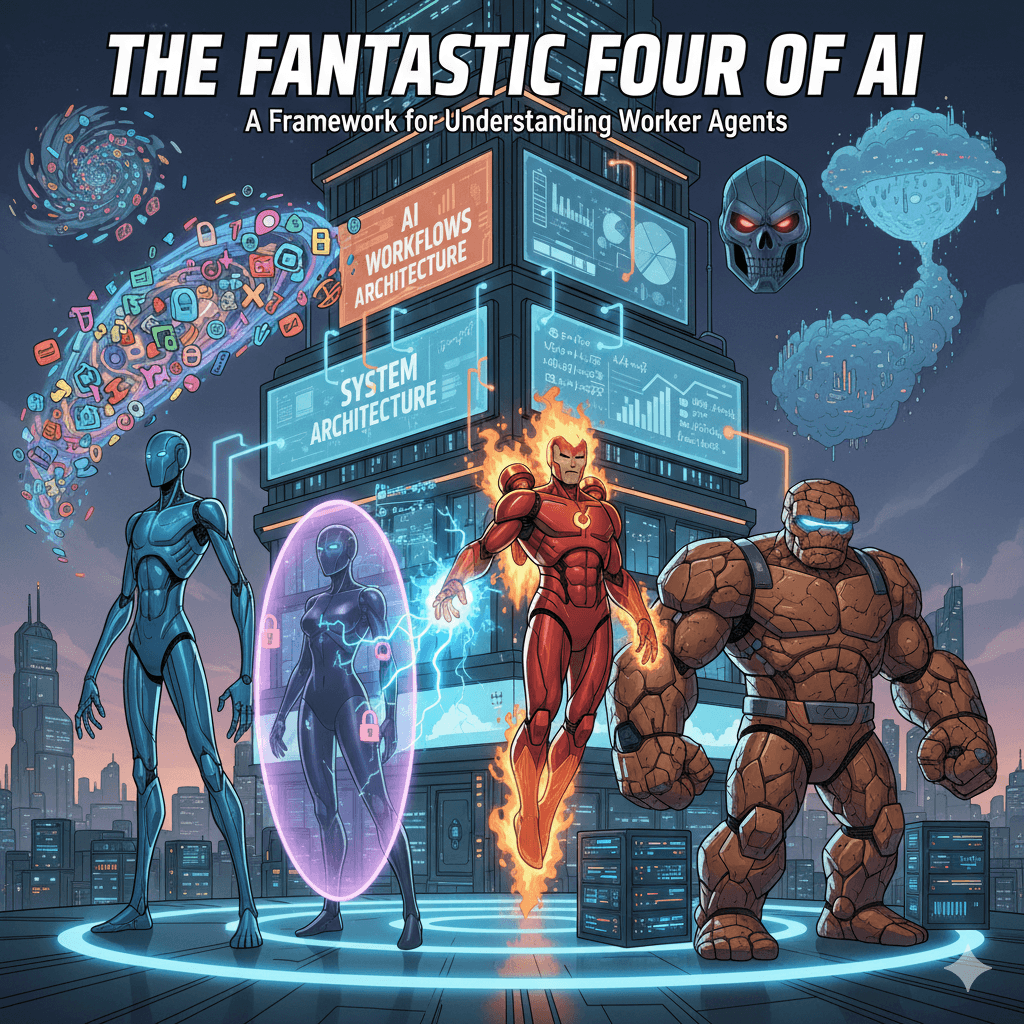
The Fantastic Four of AI: A Framework for Understanding how worker agents contribute to the processes of an ai system.
In the bustling metropolis of artificial intelligence, where data streams like rivers and algorithms hum like a cityscape, a new kind of superhero team is emerging. Not with capes and cosmic rays, but with code and complex neural networks. We’re talking about worker agents, the unsung heroes of modern AI systems. To truly grasp their power, their purpose, and their brilliant synergy, we need to look no further than Marvel’s First Family: the Fantastic Four.
The metaphor isn’t just for fun; it’s a perfect lens through which to understand the intricate roles and dynamics of these specialized AI components. Just as Reed, Sue, Johnny, and Ben combine their unique powers to tackle impossible challenges, so too do different types of worker agents collaborate to process data, secure systems, and execute complex tasks. This blog post will take a deep dive into this framework, exploring the roles of each “superhero” agent, the dynamics of their “family,” and how this comic book-inspired model is already shaping the future of AI.
Character-to-Agent Mapping: The Fantastic Four’s Secret Origin
Every great team starts with its members. The Fantastic Four are a study in complementary powers. A brilliant mind, an unseen protector, a fiery force of nature, and an unyielding foundation. When we apply this logic to AI, the parallels become astonishingly clear.
Mr. Fantastic’s Flexibility: The Data Processing Agent
Reed Richards is the polymath scientist whose body can stretch and contort into any shape, allowing him to adapt to any physical challenge. In the world of AI, the data processing agent is our Mr. Fantastic. These agents are the most adaptable and versatile members of the team. Their “flexibility” isn’t in their physical form, but in their ability to handle a vast array of data types and formats.
Think of a modern business dealing with a torrent of unstructured data: customer emails, social media posts, sensor readings, and legacy database entries. A data processing agent must “stretch” to understand and normalize all of this information. It can pull text from a PDF, extract numbers from a spreadsheet, and parse metadata from an image, all while maintaining the integrity of the information. Just as Mr. Fantastic can coil himself into a spring or flatten himself into a parachute, a data processing agent can transform raw data into a structured format ready for analysis. They are the initial problem-solvers, the ones who make sense of chaos, ensuring that all other agents have a clean, usable foundation to work with. Without them, the entire AI system would be like a lab full of unorganized notes—brilliant but unusable.
Invisible Woman’s Protective Barriers: The Security and Privacy Agent
Sue Storm possesses the power to manipulate light, rendering herself and others invisible, and, most importantly, creating powerful force fields. She is the team’s protector, the first line of defense against any threat. Her AI counterpart is the security and privacy agent. In an era where data breaches and privacy concerns are paramount, this agent is indispensable.
The security and privacy agent builds “invisible barriers” around the AI system. Their force fields are the firewalls, encryption protocols, and access control policies that safeguard sensitive information. They monitor for suspicious activity, protect data in transit and at rest, and ensure compliance with regulations like GDPR and CCPA. They are constantly on guard, making sure that malicious actors cannot breach the system’s defenses. Furthermore, their “invisibility” power represents their ability to anonymize and de-identify data, protecting user privacy while still allowing for valuable analysis. Just as Sue’s force fields are essential for keeping her family safe, the security and privacy agent is the guardian of the entire AI ecosystem, ensuring trust and integrity.
Human Torch’s Speed and Power: The Execution Agent
Johnny Storm, the brash and powerful Human Torch, can erupt in flames and fly at incredible speeds. He is the team’s engine of action, delivering rapid and powerful results. In the AI framework, the execution agent is the Human Torch. Once the data has been processed and secured, the execution agent bursts into action, delivering the final product.
These agents are designed for one thing: speed. They take the insights from other agents and translate them into real-world actions. In a financial system, an execution agent might rapidly process a trade based on market analysis. In a logistics network, it could instantly reroute a delivery to avoid a traffic jam. Their “fiery” nature represents their ability to handle computationally intensive tasks, performing complex calculations and delivering a response in milliseconds. They are the “doing” part of the system, the ones that deliver the tangible outcome. While other agents prepare the groundwork, the execution agent is the one that says, “Flame on!” and delivers the final, decisive blow.
The Thing’s Reliability: The Infrastructure Agent
Ben Grimm, transformed into the monstrous, rock-hard Thing, is the team’s anchor. He is the strong, reliable foundation, able to withstand incredible punishment and provide a stable base for his teammates. Similarly, the infrastructure agent is the backbone of any robust AI system.
This agent is responsible for the system’s stability and reliability. They manage the underlying hardware and software, ensuring that all other agents have the resources they need to function. They are like the girders of the Baxter Building, providing a stable platform for every operation. The infrastructure agent handles resource allocation, load balancing, and fault tolerance. If one component fails, the infrastructure agent steps in to heal the system, like The Thing shrugging off a blow from a supervillain. They are the guardians of uptime, the masters of scalability, and the quiet, strong foundation that allows the more specialized agents to perform their duties without worrying about the system’s integrity. Their reliability is the bedrock upon which the entire AI “family” stands.
Team Dynamics: The Baxter Building and Family Bond
The Fantastic Four aren’t just four individuals with powers; they are a family. Their synergy and ability to communicate are what make them a formidable force. In the AI world, this concept of “family” is the key to effective AI coordination.
The Family Bond: Inter-Agent Communication
Just like the Richards-Storm family, AI worker agents rely on a deep level of communication to function. This “family bond” is the inter-agent communication protocol. It’s the network of APIs, message queues, and shared data spaces that allow Mr. Fantastic to pass clean data to the Human Torch, or the Invisible Woman to alert The Thing of a security breach. This communication must be seamless, low-latency, and fault-tolerant. When one agent completes its task, it must be able to instantly signal the next agent in the workflow, ensuring a smooth and efficient process. Without this “family bond,” the team would be a collection of isolated heroes, each powerful on their own, but unable to tackle a truly complex mission.
The Baxter Building: The AI System Architecture
The Baxter Building is more than just a home; it’s the Fantastic Four’s headquarters, a hub of advanced technology and a central command center. In our AI metaphor, the Baxter Building is the AI system architecture. It’s the blueprint that defines how all the agents interact, where data is stored, and what the overall workflow looks like.
The architecture determines whether the system is centralized or decentralized, how agents are deployed, and how they scale. A well-designed “Baxter Building” ensures that there are no bottlenecks and that agents can be added or removed without disrupting the entire system. It’s the grand plan that brings all the individual components together into a cohesive, functional whole.
Team Missions: Complex AI Workflows
Every villain is a new challenge, a new “mission” for the Fantastic Four. In the same way, every complex business problem is a complex AI workflow. Consider a company analyzing customer sentiment from social media.
- Mr. Fantastic (Data Processing Agent) stretches to scrape data from Twitter, Facebook, and Instagram, normalizing all the different formats.
- The Invisible Woman (Security Agent) puts up a protective barrier, anonymizing user data to protect privacy.
- The Human Torch (Execution Agent) then “flames on,” running a powerful sentiment analysis algorithm to identify trends in real-time.
- The Thing (Infrastructure Agent) provides the stable cloud computing foundation for the entire process, ensuring the system doesn’t crash under heavy load.
The successful completion of this workflow is a true team effort, a testament to the seamless coordination of the entire Fantastic Four of AI.
Villain Threats: System Challenges and Edge Cases
Every superhero team has their rogues’ gallery, and for the Fantastic Four of AI, these “villains” are the inevitable challenges and edge cases that threaten to destabilize the system.
- The Impossible Man: This chaotic, reality-warping villain represents unstructured and anomalous data. A data processing agent must be flexible enough to handle these “Impossible Man” data points without breaking the entire system.
- Dr. Doom: The tyrannical Dr. Doom represents security threats and malicious attacks. A security agent must be constantly vigilant and prepared to repel any attempts to breach the system’s defenses.
- Galactus: The Devourer of Worlds represents a massive, unexpected surge in data or computational load. An infrastructure agent must be robust and scalable enough to handle this “cosmic” demand without collapsing.
By understanding these “villains,” developers can design more resilient and robust AI systems, with protocols in place to handle unexpected challenges and edge cases.
The Future Is Fantastic
The metaphor of the Fantastic Four isn’t just a clever analogy; it’s a practical blueprint for building the next generation of AI systems. By thinking of AI as a team of specialized, yet deeply connected, worker agents, we can move beyond monolithic, single-purpose models and into a world of collaborative, intelligent ecosystems.
From healthcare to finance, from logistics to creative industries, the applications are limitless. In healthcare, a data processing agent could normalize patient records from various clinics, a security agent could protect sensitive health information, an execution agent could run a diagnostic algorithm, and an infrastructure agent could ensure the system is always available for doctors. The same model applies to any industry facing complex data and operational challenges.
This framework provides a clear path forward for developers, project managers, and business leaders alike. It encourages a modular, scalable approach to AI development, emphasizing the importance of specialized roles and seamless communication. Just as Reed Richards always finds a solution, Sue Storm always protects her family, Johnny Storm always delivers the punch, and Ben Grimm always stands strong, the Fantastic Four of AI are ready to tackle the future’s biggest challenges. So the next time you hear about worker agents or complex AI systems, just think of the Baxter Building, a team of heroes, and a mission to make the world a more intelligent, efficient, and fantastic place.
Related Insights

How Google I/O 2026 Reshuffled the Search Algorithm—And How ContentXIR Empowers Brands to Dominate the Agentic Web
Google just restructured its search core around Gemini 3.5 Flash, 24/7 background Search Agents, and dynamic Generative UI. Learn how ContentXIR’s causal engine delivers the diagnostic insights needed to survive this new age of SEO.

The Neural Search Shift Season 04: GEO Protocols (The Finale) Episode 07: A/B Testing for Algorithms
We have spent this season re-engineering your content, your code, and your PR for the Generative AI era. But how do you actually know if it is working? In the…

The Neural Search Shift Season 04: GEO Protocols (The New Playbook) Episode 06: The Itinerary Engine
For brick-and-mortar businesses, event spaces, and localized services, the game has fundamentally changed. The “Map Pack” is no longer the final destination. Users are no longer asking search engines to…