
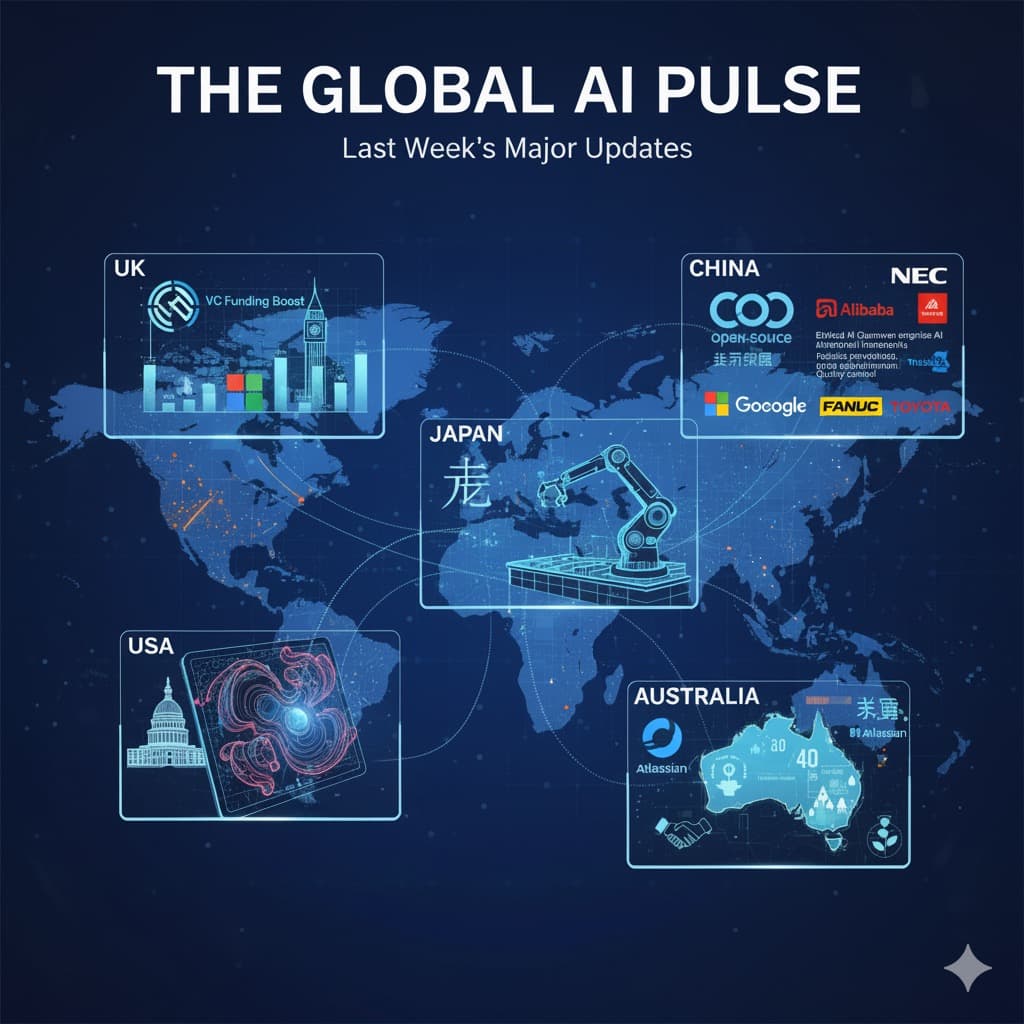
The Global AI Pulse: Last Week’s Major Updates
The world of Artificial Intelligence continues its relentless march forward, with breakthroughs, strategic investments, and regulatory discussions shaping the landscape across continents. This past week delivered a flurry of activity, with various brands making significant moves. Here’s a quick rundown of key AI developments from last week in major markets, including specific examples and brand updates:
China: Scaling Up and Open Sourcing for Broader Impact
China’s AI sector continues to be a global powerhouse, characterized by aggressive scaling and a growing embrace of open-source initiatives, now with more brand-specific examples.
• Large Model Race Intensifies (Baidu, Alibaba, Tencent): The competition among China’s tech giants to advance their large language models (LLMs) is fierce. Last week, Baidu reportedly showcased internal benchmarks for its Ernie Bot’s improved multimodal capabilities, demonstrating better understanding of complex image and video inputs alongside text. Alibaba Cloud also highlighted new advancements in its Tongyi Qianwen model, particularly in enterprise-level customization for specific industry verticals. Tencent continued to integrate its Hunyuan AI model across its diverse ecosystem, from WeChat to cloud services, signaling a broader rollout strategy.
• Open-Source Momentum (Huawei, SenseTime): A notable trend from China is the increasing contribution to and adoption of open-source AI frameworks and models. Huawei announced further contributions to its MindSpore AI computing framework, fostering a more collaborative ecosystem for developers. Similarly, SenseTime, known for its computer vision prowess, made parts of its foundational models more accessible to researchers and smaller companies, aiming to accelerate innovation across the board.
Japan: Ethical AI and Industrial Application with Precision
Japan is steadily building its AI capabilities, with a particular emphasis on ethical considerations and practical applications within its robust industrial sectors, often involving leading tech and manufacturing brands.
• Responsible AI Frameworks (NEC, Hitachi): Discussions around establishing comprehensive ethical AI guidelines gained traction last week, with government bodies and industry leaders emphasizing transparency, accountability, and fairness. Companies like NEC continued to publish white papers and participate in forums detailing their approach to ethical AI development, particularly in areas like public safety and smart city solutions. Hitachi also highlighted its internal guidelines for AI use, focusing on human-centric design and bias mitigation in its industrial AI applications.
• Manufacturing and Robotics Integration (Fanuc, Toyota): Several Japanese manufacturing firms showcased new AI-powered solutions. Fanuc, a global leader in factory automation, demonstrated new AI-driven predictive maintenance features for its robots, allowing for earlier detection of potential malfunctions and reducing downtime. Toyota, in its manufacturing divisions, rolled out AI systems for enhanced quality control on assembly lines, using computer vision to spot minute defects that might be missed by the human eye, further refining its renowned production system.
UK: Investment, Regulatory Discussions, and Sector-Specific Growth
The UK is positioning itself as a hub for AI innovation, attracting significant investment while also grappling with the complexities of AI regulation, with a focus on specific high-growth sectors.
• Funding Boost for Startups (DeepMind spin-offs, Tractable): The past week saw a fresh wave of venture capital funding directed towards promising UK-based AI startups. While not a “brand update” for DeepMind directly, several companies founded by ex-DeepMind researchers or leveraging similar foundational AI concepts secured substantial investments, particularly in AI-driven drug discovery and scientific research. Tractable, a UK AI firm specializing in accident and disaster recovery using computer vision, announced new partnerships with major insurance providers, expanding its market reach and showcasing practical AI application.
• AI Safety Summit Preparations (Government initiatives): As the UK prepares for upcoming discussions on AI safety and governance, parliamentary committees and expert panels held meetings to refine policy proposals. While not brand-specific, this affects all tech companies operating in or looking to enter the UK market, setting the stage for future regulatory compliance and opportunities.
USA: Generative AI Dominance and Policy Debates Continue
The United States continues to lead in generative AI innovation, alongside ongoing debates about its societal impact and the need for federal regulation, with major players driving the narrative.
• Generative AI Expansion (OpenAI, Google, Microsoft): Tech giants and startups alike unveiled new features and applications leveraging generative AI. OpenAI teased advancements in its upcoming models, focusing on improved reasoning and longer context windows, while its API saw increased adoption for custom enterprise solutions. Google announced new generative AI capabilities integrated into its Workspace suite, making tools like Gemini more deeply embedded into productivity applications. Microsoft continued its aggressive rollout of Copilot across its product ecosystem, demonstrating how generative AI can enhance everything from coding (GitHub Copilot) to business intelligence (Power BI integration).
• Washington’s AI Stance (Amazon, IBM testimony): Conversations in Washington D.C. intensified regarding the future of AI regulation. Executives from companies like Amazon and IBM testified before congressional committees, advocating for a balanced approach to regulation that fosters innovation while addressing concerns around data privacy, intellectual property, and algorithmic bias.
Australia: AI for Social Good and Research Collaboration Down Under
Australia is increasingly leveraging AI for public benefit, with a strong focus on environmental applications and international research partnerships, often involving both established institutions and innovative startups.
• Environmental AI Initiatives (CSIRO, Local Startups): New projects were announced last week utilizing AI to address pressing environmental challenges. CSIRO, Australia’s national science agency, detailed advancements in AI models for predicting bushfire spread with greater accuracy, aiding in early warning systems. Several local startups, often in partnership with agricultural tech companies, showcased AI solutions for optimizing water usage in farming and monitoring crop health through drone imagery and machine learning.
• International Research Links (Universities, Atlassian): Australian universities and research institutions highlighted growing collaborations with global partners on cutting-edge AI research, particularly in areas like machine learning interpretability and AI ethics. While not a direct “update,” Atlassian, a major Australian software company, continues to invest heavily in AI research and development for its productivity tools, often collaborating with academic institutions and contributing to global AI best practices.
The global AI landscape is dynamic and multifaceted. Each region, with its leading brands and innovators, brings unique strengths, challenges, and perspectives to the table, collectively driving the rapid evolution of this transformative technology
Related Insights

How Google I/O 2026 Reshuffled the Search Algorithm—And How ContentXIR Empowers Brands to Dominate the Agentic Web
Google just restructured its search core around Gemini 3.5 Flash, 24/7 background Search Agents, and dynamic Generative UI. Learn how ContentXIR’s causal engine delivers the diagnostic insights needed to survive this new age of SEO.

The Neural Search Shift Season 04: GEO Protocols (The Finale) Episode 07: A/B Testing for Algorithms
We have spent this season re-engineering your content, your code, and your PR for the Generative AI era. But how do you actually know if it is working? In the…

The Neural Search Shift Season 04: GEO Protocols (The New Playbook) Episode 06: The Itinerary Engine
For brick-and-mortar businesses, event spaces, and localized services, the game has fundamentally changed. The “Map Pack” is no longer the final destination. Users are no longer asking search engines to…