
The memory vs the search | The neural search shift
We have spent six days looking inside the machine’s brain. Now, we distinguish between what the machine remembers (its training) and what it sees (your content). This distinction is the single most important concept for 2026 marketing strategy.
There is a fundamental misunderstanding in the marketing world. Brands think they need to “teach” ChatGPT about their products. They think they need to be part of the “Training Data.” They are wrong.
You cannot easily change an AI’s training data—that is frozen in the past. But you can control what it reads in real-time. In this Season Finale, we decode the difference between Parametric Memory(Training Data) and Non-Parametric Memory (RAG), and why your entire strategy must focus on the latter.
Part 1: The Decoder (The Science)
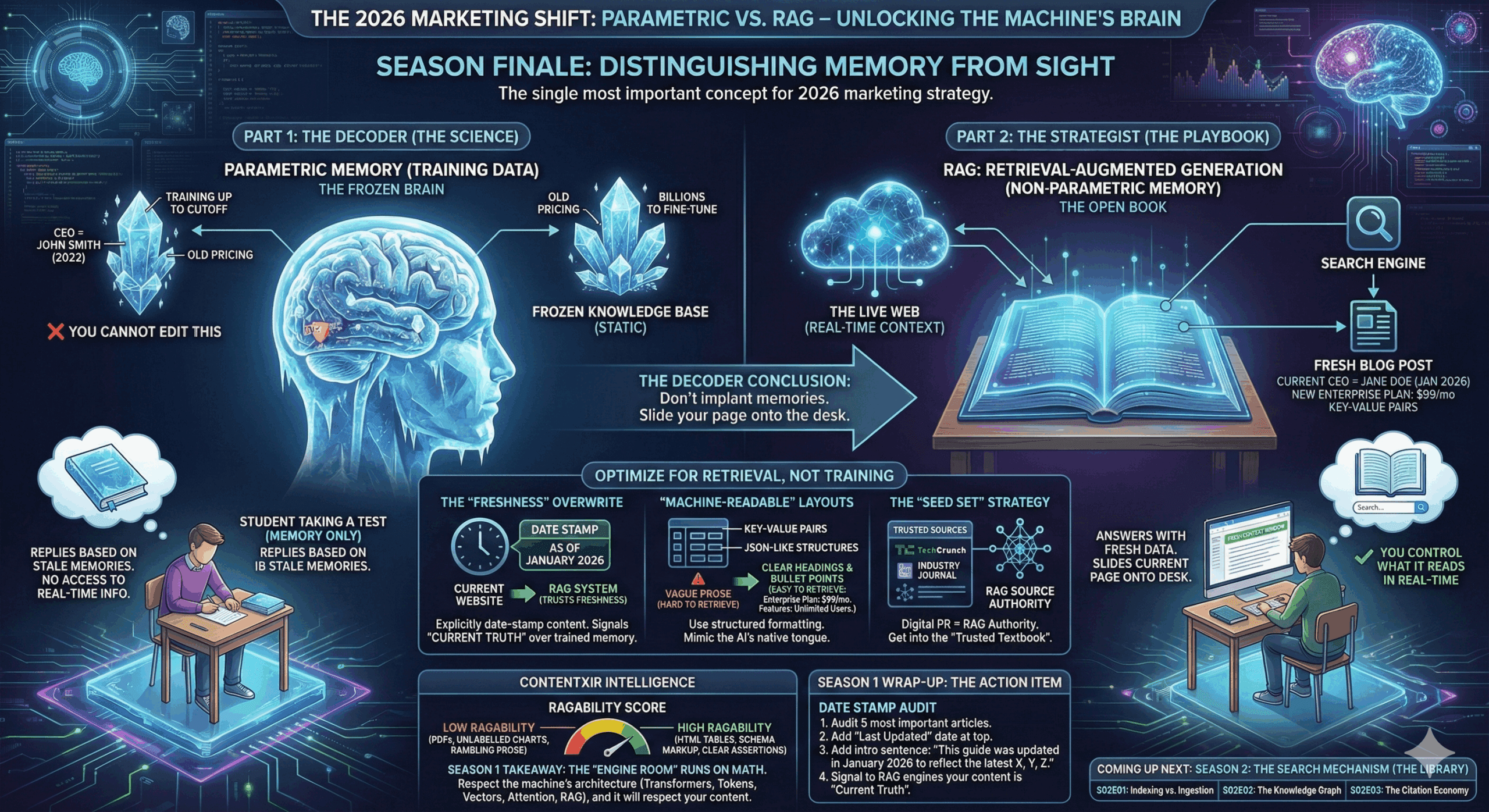
The Frozen Brain vs. The Open Book
To understand how a GenAI engine answers a query, imagine a student taking a test.
1. Training Data (Parametric Memory)
This is what the student studied before the test.
• It is the “frozen” knowledge base. For GPT-4, this might include the entire internet up to a specific cutoff date.
• The Problem: It is static. If you changed your pricing yesterday, the “Training Data” doesn’t know. It still “remembers” your old price.
• The Effort: Changing training data requires billions of dollars and months of “fine-tuning.” You, as a brand, cannot directly edit this.
2. RAG: Retrieval-Augmented Generation (Non-Parametric Memory)
This is the “Open Book” portion of the test.
• When the student (AI) doesn’t know the answer (or wants to be sure), it looks at the textbook on the desk.
• The “Textbook” is the Live Web.
• RAG Mechanism: The search engine fetches your current blog post, temporarily feeds it into the Context Window (see Ep 5), and generates an answer based on that fresh text.
The “Decoder” Conclusion:
You are not trying to implant memories in the AI’s brain. You are trying to slide your page onto its desk right before it answers the question.
Part 2: The Strategist (The Playbook)
Optimize for Retrieval, Not Training
Stop worrying if ChatGPT “knows” your brand from 2021. Focus on whether it can “retrieve” your brand in 2026.
1. The “Freshness” Overwrite
RAG systems are designed to trust fresh context over stale training.
• Scenario: The Training Data says “CEO = John Smith” (from 2022). Your Website says “CEO = Jane Doe” (Updated Today).
• The Strategy: Explicitly date-stamp your content. “As of January 2026, the current CEO is…”
• Why: This gives the RAG system a “temporal anchor.” It signals that the retrieved data is superior to the trained memory.
2. “Machine-Readable” Layouts
If RAG is about the AI “glancing” at your page to find an answer, make the answer jump out.
• The Strategy: Use Key-Value Pairs in your formatting.
• Hard to Retrieve: “We offer a variety of plans that act as solutions for different needs…” (Vague).
• Easy to Retrieve: “Enterprise Plan: $99/mo. Features: Unlimited Users.”
• This works because it mimics the JSON data structures the AI was trained on. It is “native tongue” formatting.
3. The “Seed Set” Strategy
RAG engines don’t just look anywhere; they look at trusted sources first.
• The Strategy: Digital PR is now about RAG Source Authority. Getting mentioned in a high-authority publication (like TechCrunch or a major Industry Journal) puts your brand in the “Trusted Textbook.”
• Even if your site isn’t retrieved, the AI might retrieve the article about you.
ContentXir Intelligence
The “RAGability” Score
We are entering an era where we measure “RAGability”—how easily can a machine extract facts from your page?
• Low RAGability: PDFs, text inside images, unlabelled charts, rambling prose.
• High RAGability: HTML tables, Schema markup, clear headings, direct assertions.
The Season 1 Takeaway:
The “Engine Room” runs on math, not magic. It uses Transformers to read, Tokens to count cost, Vectors to map meaning, Attention to focus, and RAG to fetch facts.
If you respect the machine’s architecture, the machine will respect your content.
Season 1 Wrap-Up: The Action Item
The “Date Stamp” Audit.
1. Go to your 5 most important articles.
2. Do they have a “Last Updated” date visible at the top?
3. The Task: If not, add it. Even better, add a sentence in the intro: “This guide was updated in January 2026 to reflect the latest X, Y, Z.”
4. You just signaled to every RAG engine that your content is the “Current Truth.”
Coming Up Next: Season 2
Season 02: The Search Mechanism
We leave the “Brain” and enter the “Library.” How do Google AIO, Perplexity, and Bing actually find your content before the AI reads it?
• S02E01: Indexing vs. Ingestion (The New Crawl Budget)
• S02E02: The Knowledge Graph (Google’s Secret Weapon)
• S02E03: The Citation Economy (Winning the Footnote)
Related Insights

How Google I/O 2026 Reshuffled the Search Algorithm—And How ContentXIR Empowers Brands to Dominate the Agentic Web
Google just restructured its search core around Gemini 3.5 Flash, 24/7 background Search Agents, and dynamic Generative UI. Learn how ContentXIR’s causal engine delivers the diagnostic insights needed to survive this new age of SEO.

The Neural Search Shift Season 04: GEO Protocols (The Finale) Episode 07: A/B Testing for Algorithms
We have spent this season re-engineering your content, your code, and your PR for the Generative AI era. But how do you actually know if it is working? In the…

The Neural Search Shift Season 04: GEO Protocols (The New Playbook) Episode 06: The Itinerary Engine
For brick-and-mortar businesses, event spaces, and localized services, the game has fundamentally changed. The “Map Pack” is no longer the final destination. Users are no longer asking search engines to…