
The AI Marketing Transformation (Part 1): Solving the “Who Are We Talking To?” Problem
In the digital age, we are drowning in data but starving for insight.
Most marketing teams can tell you exactly how many clicks they got yesterday. They can tell you the bounce rate of their landing page or the open rate of their newsletter. But if you ask them a simple, fundamental question—“Who are you actually talking to?”—the room often goes silent.
Or worse, they hand you a generic PDF that says: “Our target is Males, 25–40, living in Tier 1 cities.”
That isn’t a person. That’s a statistic. And you cannot build a relationship with a statistic.
This is the first and most critical bottleneck in the marketing workflow: The Identity Gap.
The Business Problem: Flying Blind in a Data Storm
The problem isn’t a lack of data; it’s a lack of cohesion. You have sales data in your CRM, behavioral data in Google Analytics, and engagement data on social media. None of these systems talk to each other effectively.
Because of this fragmentation, marketers revert to “spray and pray” tactics. They create generic content that targets everyone, which means it resonates with no one. They waste budget chasing “traffic” instead of chasing “people.”
To fix this, we need to stop looking at rows on a spreadsheet and start looking at Customer Journeys. We need to move from Demographics (who they are) to Psychographics and Behavior (what they think and do).
The Approach: From Data Points to Narratives
The solution requires a system that connects the dots. We need to visualize the human behind the screen.
A true understanding of the customer requires mapping their lifecycle. We need to know:
- The Trigger: What pain point caused them to start Googling in the first place?
- The Process: What blogs did they read? What comparisons did they make?
- The Decision: What was the final tipping point that made them convert?
When you understand the journey, you can intervene at the right moment with the right message.
The Solution: The Consumer Insights Engine
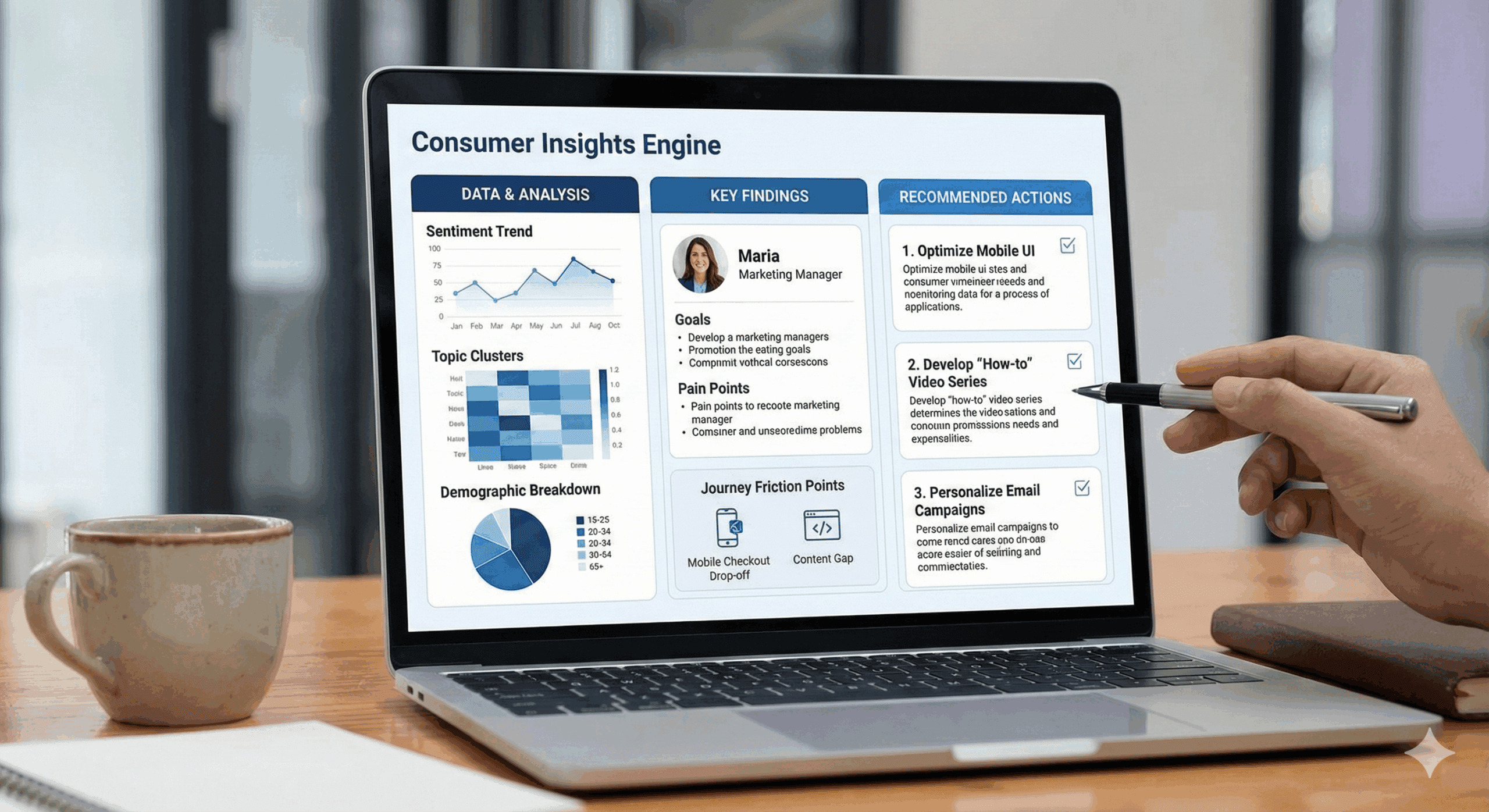
This was the driving force behind the first app in my ecosystem: the Consumer Insights Engine.
I wanted to build a “brain” for marketing operations—a tool that ingests data and outputs actionable human narratives. Instead of giving you a pie chart, it gives you a Persona and a Journey Map.
Here is how it solves the Identity Gap:
1. It Humanizes the Data (User Personas)
Instead of vague demographics, the engine generates detailed profiles like “Maria” or “David”.
- Maria, for example, is a 38-year-old Marketing Manager in Austin.
- Her goal isn’t just “buy software”; it’s to “justify marketing spend by demonstrating clear ROI”.
- Her pain point is that her “small team struggles to produce enough high-quality content”.
Now, when you write an ad, you aren’t writing for “Females 35+.” You are writing to Maria, promising her a way to scale her small team’s output.
2. It Maps the Full Lifecycle (User Journeys)
Understanding who Maria is is only half the battle. You also need to know where she is. The Consumer Insights Engine visualizes the entire timeline:
- Awareness Stage: The AI identifies that Maria starts by Googling terms like “how to scale content marketing” and reading Tech Review Blogs. Insight: This is where you need educational blog posts.
- Consideration Stage: She clicks on a “Top 10 Content Intelligence Platforms” article and thinks, “Is it affordable?”. Insight: This is where you need clear pricing pages and comparison charts.
- Decision Stage: She finally signs up for a free trial after seeing an onboarding email.
The Result
By using the Consumer Insights Engine, you stop guessing. You align your entire marketing strategy—from blog topics to ad creatives—around the actual thoughts, feelings, and actions of real buyers like Maria and David.
Next Up: Once you know who you are talking to, how do you know what they are searching for right now? In Part 2, we will tackle Real-Time Market Demand and the danger of outdated content calendars.
Ready to meet your customers? Explore the Consumer Insights Engine here https://www.contentxir.com/products/consumer-insights-engine
Related Insights

How Google I/O 2026 Reshuffled the Search Algorithm—And How ContentXIR Empowers Brands to Dominate the Agentic Web
Google just restructured its search core around Gemini 3.5 Flash, 24/7 background Search Agents, and dynamic Generative UI. Learn how ContentXIR’s causal engine delivers the diagnostic insights needed to survive this new age of SEO.

The Neural Search Shift Season 04: GEO Protocols (The Finale) Episode 07: A/B Testing for Algorithms
We have spent this season re-engineering your content, your code, and your PR for the Generative AI era. But how do you actually know if it is working? In the…

The Neural Search Shift Season 04: GEO Protocols (The New Playbook) Episode 06: The Itinerary Engine
For brick-and-mortar businesses, event spaces, and localized services, the game has fundamentally changed. The “Map Pack” is no longer the final destination. Users are no longer asking search engines to…